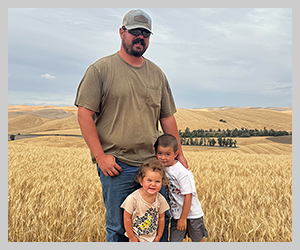






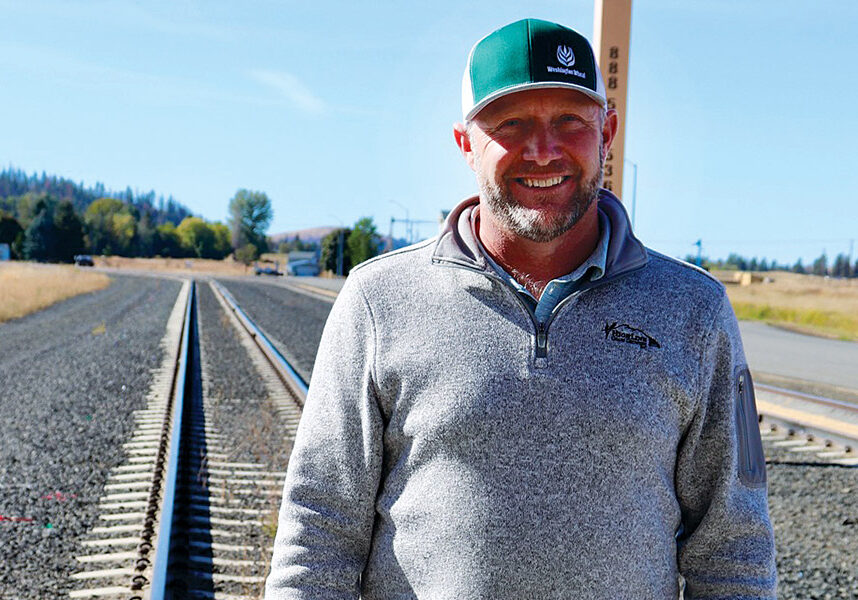
Having been raised in rural Montana wheat country, it’s probably not surprising that Brad Wiley ended up with a career in the grain industry. Wiley is the foreman of HighLine Grain Growers’ shuttle train loading facility in Four Lakes, Wash. He traveled a circuitous route in his career before joining the HighLine team in 2015.
Wiley’s family farmed in his youth, but due to tough times in the early 1980s, his father took a job with the Cargill corporation. The family moved from the Judith Basin area to Chester, Mont. During Wiley’s high school years, Cargill transferred his father to Arlington, Ore.
“It was about that time that I began to seriously consider the grain industry as a potential career path,” said Wiley.
Wiley graduated in 1990 and attended college for a year before deciding to begin his working career in the grain industry. After accepting a position with Cargill, the company paid him to take classes at Panhandle State University in Oklahoma.
The opportunity to move back home to Arlington presented itself, so Wiley transferred to a position with Cargill there. Not only was he able to return to the Pacific Northwest (PNW), but he renewed a friendship with a former schoolmate, Melissa, and they were soon married. Three years later, Cargill transferred Wiley to Lakota, N.D.
“I really would have preferred to stay in the PNW, but by this time, I had extensive background in fertilizer handling and custom application. I had also worked handling grain commodities, including loading rail cars and river barges,” said Wiley. “I was placed where my experience was most beneficial to my employer.”
The next stop was Winchester, Ohio. This region had corn, soybeans, and soft red winter wheat as the main crops. Wiley was still working with custom fertilizer applications at this time.
“Ironically, about one year after moving to Ohio, I was transferred to Ord, Neb. I say it was ironic because I had previously said I never wanted to move to Nebraska,” said Wiley. “However, those four years were some of my favorite ones. I worked with great people there. I was involved with building a new, 360,000-bushel annex facility, my first major construction project. It was my first shuttle train loading experience.
Cargill was moving about 8-12 million bushels of grain annually at that facility, most of which was corn.
Wiley then was transferred to nearby Albion, Neb. There was business growth there with a new ethanol plant being built adjacent to the Cargill facility. Wiley was involved with another facility expansion project there in preparation for being the primary supplier of corn for the nearby ethanol plant. It was at this time the first major change to Wiley’s career path came about, and it was a significant move in geographic location and in the culture of his new company.
“I really didn’t have any plans to leave Cargill, but I always kept my eyes open for an opportunity to return to the PNW if the right position came up,” said Wiley. “That opening came at Mid-Columbia Producers (MCP) in Oregon.”
Wiley first interviewed for a general manager trainee position, but didn’t land that job. Before heading back to Nebraska, he was offered their operations manager post, which he accepted.
“It was an entirely different company structure for me,” said Wiley. “I left a huge corporation where all the company culture and operational procedures were well established to a healthy smaller grain cooperative where my job entailed establishing new systems and programs and upgrading facilities throughout the company.”
Wiley began building and refining new transportation and safety systems and other training programs. Some of the MCP stations and facilities had not been upgraded or maintained in a timely manner, so Wiley worked diligently to upgrade the cooperative’s stations and locations.
“Fortunately, MCP had a management team and board of directors that saw the value of reinvesting in their facilities to improve their value and reduce long-term operational costs,” noted Wiley. “I enjoyed my eight years there very much.”
Wiley spent one year as an MCP grain trader, which widened his experience and knowledge of the business side of the grain industry. Then came perhaps the most critical point in Wiley’s entire career. He suddenly found himself without a job. When the MCP general manager who had hired Wiley finally retired, the manager trainee took over, and his management style did not mesh well with Wiley’s. Wiley was terminated, and the new general manager brought in someone whose management style better fit what he wanted.
“Here I am, 23 years into my career, looking for a job,” recalled Wiley. “I had been all over the country, had been exposed to nearly all aspects of the grain industry, including grain export. I had many years of management experience but was unemployed. Curiously, losing my job wasn’t a totally negative experience. It may seem odd, but reflecting back, it gave me an opportunity for self-examination and personal growth.”
At a unique crossroads in his career, Wiley had many good offers for new jobs, including his former employers at Cargill. Wiley decided to take a position with Haskins Construction, a company he had worked with over the years on grain station building and remodeling projects. While he enjoyed his year with Haskins, it didn’t take Wiley long to realize how much he missed the grain industry. He began another job search.
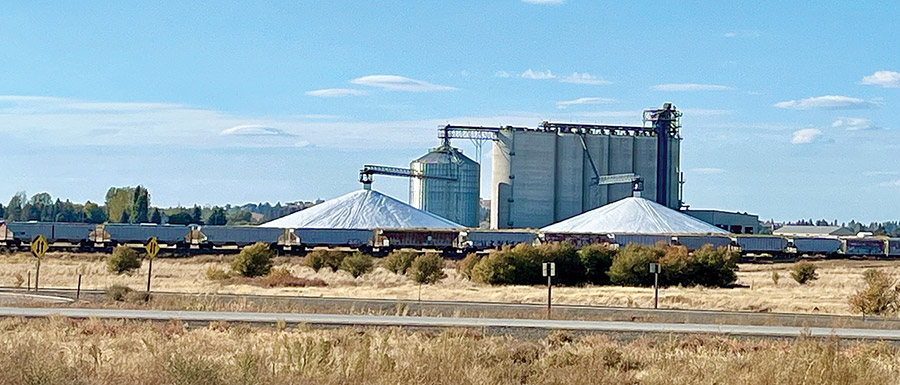
Wiley was hired by a group of grain companies, HighLine Grain Growers, to build a new rail loading facility at Four Lakes, Wash. HighLine had been formed by necessity. The potential loss of grain rail shipments to export markets for hundreds of central and eastern Washington growers was at stake. BNSF, the major rail carrier, had announced they could no longer serve their facilities with large train units because the track could no longer safely handle the traffic. A solution was needed, and after extensive research and planning, the decision was made to merge several grain companies and build a shuttle train loading facility that would have functional access to the main BNSF line.
By the time Wiley was hired, HighLine was already in the beginning stages of constructing their Four Lakes grain train loading facility.
“I wanted to stay in the PNW, so landing here at HighLine has been almost like a dream come true for myself and my family,” said Wiley.
Wiley was established as the foreman of the shuttle train facility and later as the operations manager of the east region of HighLine grain stations and facilities.
“I was probably the only person interested in the Four Lakes position who had extensive experience running trains, shuttle loaders and also had experience managing grain facilities and construction project management proficiency,” said Wiley.
Wiley hit the ground running, and with the essential assistance of Russ Felker, who had been with Almira Farmer’s Warehouse Company for years, the facility was soon completed and ready to receive and ship grain cars.
Wiley is impressed with how HighLine was able to build the $30 million facility at Four Lakes, and how efficiently it has operated the station from the very beginning.
“The very first shuttle train scheduled was an unload and reload job,” said Wiley. “Normally, you expect a few minor glitches. In this case, we were the first shuttle facility to unload and reload back-to-back under the allotted time limit. We have never missed a shuttle train loading deadline in 10 years. We also have never had a loss of time accident in those 10 years.
“I admit I’m proud of our record and the great job done by our full-time, five-man crew here at Four Lakes. I can’t say enough about the fantastic job they do every day.”
Wiley believes HighLine made outstanding decisions in designing, planning, and operating the company.
“From east to west, most of the existing internal structure of the prior companies stayed the same. Foremen have the same crews, etc. A concerted effort was made to keep intact as many teams and working relationships as possible.”
Total inside storage at Four Lakes is 2.1 million bushels. When they utilize two outside piles, that adds another 2.4 million bushels to the total capacity. About 22 million bushels of grain move through the Four Lakes facility annually. Each shuttle train of 116 cars hauls 432,000 bushels of grain. HighLine loads out about 50 unit trains each year. Wiley estimates they bring in about 500,000 bushels weekly and ship out one shuttle train weekly at around 432,000 bushels.
Most grain coming into Four Lakes is by rail, often in “scoot trains,” which are generally 75-80 cars each. They will be filled up all along the Washington Eastern Railroad, a shortline rail running from Coulee City to Cheney. Grain from growers west of Coulee City is trucked for loading onto the scoot trains. HighLine operates over 40 station locations across their system. Once loaded, the BNSF trains will reach port facilities at Longview or Kalama within 24 hours.
Wiley reflected on changes he has seen in the grain industry over the decades.
“It is truly a global market more than ever before,” he said. “It is critically important for any successful grain company to have a top-level general manager, an extremely strong grain trader, and an outstanding operations manager. Unlike in the past, grain companies don’t make their profits off storage and handling fees paid by their growers. In order to be successful in the long run, a company must be able to earn profits through margin trading and wise investing. For a company to stay prosperous, it must be financially healthy enough to reinvest in their structures and facilities for the long term.”
Wiley and his wife, Melissa, have three daughters: Danyelle, Alyson, and Kendyl. They have four grandchildren they enjoy spending time with and spoiling. For more information on HighLine Grain Growers, visit their website at highlinegrain.com.