




A major goal of the annual convention is to provide growers with updates and educational opportunities through the breakout sessions. Here’s a short summary of some of those sessions.
Dams update
Adam Ratliff, director of the Center for Sustainability and Working Rivers, spoke about recent developments surrounding the lower Snake River dams litigation, and how its proposed operational changes would affect growers. His message was that it doesn’t necessarily take an act of Congress to disable the lower Snake River dams; all opponents have to do is make it illegal to use the dams as designed!
Marketing wheat products
Jaimie Appel, Appel Heights; Bill Myers, Joseph’s Grainery; and Karl Scheuerman, Palouse Heritage, gave growers a first-person account of what it takes to sell wheat and wheat products directly to consumers.
All three experts said it’s important to differentiate yourself from your competitors. Other advice from the panel included knowing where your funding is going to come from and being willing to consider new avenues.
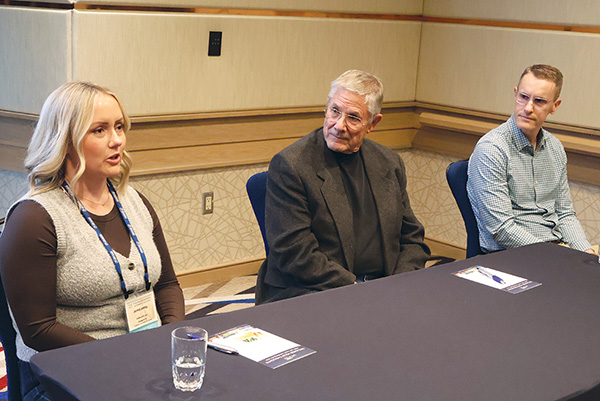
“Never give up, but be ready change,” Myers said. “It will become apparent if it is working. You never know where your opportunities are going to come from.
Appel’s business venture began with an offhand comment from her father about milling some of the family’s grain and selling the flour. She opened a storefront in downtown Colfax that sold grain, flour, baking mixes, and products made by others, but a busy family life limited the hours the store could be open. Appel pivoted to a farm fridge, which is open 24/7 and has been successful.
Myers started testing his grain at the Pullman Farmers Market. From there, he was able to get his product in some grocery stores, although he said initially, he basically had to give it away. Eventually he built up a route and began selling on the internet. He has also partnered with Linc Malt and provides them with malting ingredients for their brewery.
Scheuerman’s story is a little different than the other two. Palouse Heritage was started by his father and uncle, and he is just starting to get involved with the business. He said you have to be willing to roll up your sleeves, step out, and embrace the challenge.
For all three businesspeople, social media is a key part of their marketing strategy.
Looking ahead, Appel said she is excited to explore grant funding and networking with people who might invest in her business.
“I have all these ideas, and we could reach so many people, but that takes money,” she explained.
Scheuerman would like to see changes in the broader food supply system so that consumers are closer to the food they rely on.
“It’s great to have a global export market, but a lot of vulnerabilities exist in a global system” he said. “A lot of people around the world are dependent on imports for food staples. That’s not necessarily a good thing.”
Myers sees a lot of growth opportunity on the malting side of his business. He encouraged growers to buy a little mill and experiment with it.
“Be a supply for your neighbors,” he said.
For more information on the three panelists and their businesses, visit appelheights.com, palouseheritage.com, and josephsgrainery.com.
NRCS update
Aubrey Hoxie, east area conservationist for the Natural Resources Conservation Service (NRCS) in Washington state, provided an update to growers. NRCS Chief Aubrey Bettencourt’s focus is farmers first and keeping farmers farming, partnerships, and precision agriculture, in addition to focusing on internal affairs and ensuring field office staff have the tools they need.
Preliminary data shows that the biggest jump in program assistance in FY2025 was in the Environmental Quality Incentives Program (EQIP), which increased from $25,878,132 to $58,404,638. Agricultural Conservation Easement Program (ACEP) numbers increased from $1,235,287 to $3,161,000. The Conservation Stewardship Program (CSP) decreased slightly from $13,815,000 to $13,396,297, and the Regional Conservation Partnership Program (RCPP) went down from $7,720,654 to $7,595,234. Totals will be finalized in January.
CSP has been revamped, and details should be available soon. The national program deadline has been extended to Jan. 15. FY2025 CSP contract renewals will not go forward and will instead rollover to a classic signup. Easements have a new team that is up and running, and the program has a Jan. 15, 2026, deadline. Applications continue to be accepted for EQIP year-round, and the application ranking time frame will be Jan. 15, 2026.
Global wheat market outlook
Brian Liedl, vice president of overseas operations for U.S. Wheat Associates (USW), outlined current global supply and demand factors, including increased world wheat production and strong ending stocks, such as the consistently large crops from the Black Sea and Australia. With increased production, U.S. ending stocks are also rising.
Meanwhile, demand trends across Asia present meaningful opportunities. Rapid population growth, economic expansion, and shifting diets are driving a sustained increase in wheat consumption. Over the past two decades, per-capita wheat demand in the region has grown by more than 60%. As a result, milling demand continues to rise sharply. Overall, these forces underscore the importance of developing and maintaining connections in export markets. Liedl highlighted the need for continued engagement, quality differentiation, and maintaining a reliable supply of high-quality wheat, especially as global competition continues to intensify.
At the close of his presentation, Kevin Klein, chairman of the Washington Grain Commission, presented Liedl with an honorary plaque to thank him for his five years of service as an industry representative.
“I’m proud of my years of service at the Washington Grain Commission, not just because I accomplished something, but because I helped continue something — the legacy of wheat farming and its positive global impact — alongside dedicated growers like you. I’m grateful for the opportunity to continue to do so in my new role at U.S. Wheat Associates and look forward to continuing serving you,” Liedl said.