





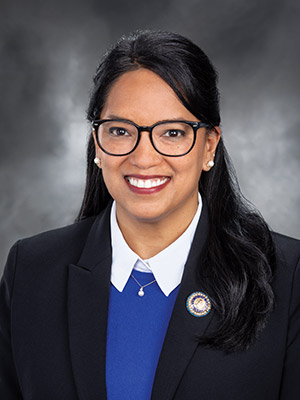
Rep. Kristine Reeves, District 30 Chair of the House Agriculture and Natural Resources Committee
Further ReadingPolicy
By Trista Crossley
Editor
What are your priorities for the 2026 Legislative Session?
While I am working on a variety of policy proposals, including textile recycling to take on the impacts of fast fashion on our waste streams, tobacco/vape regulation to protect our kids, natural resource policy that provides balance between the state’s economic needs and our vision for environmental protections, and wildfire response policy that works to address liability for strong investments in protection, the top priority for me this session is combatting food insecurity through farm supports that protect agriculture efforts in our state, works at driving down the cost of groceries for working families, and shoring up the food bank system.
What budget concerns are at the top of your committee list? How worried should growers be about WSDA funding and cuts to programs they rely on?
I am most worried about the loss of 3,700 farms in the state over the last five years. I am concerned about the impacts of the loss of federal funding and programs growers have come to rely upon via the U.S. Department of Agriculture, as I do not believe the state or Washington taxpayers will have the capacity to back-fill these losses immediately, if at all, and given these are our federal tax dollars being withheld from our growers, I worry about the deepening of farm loss in our state. It is why I am introducing a state farm bill to draw attention to the needs of the farm community in meeting our state’s food security needs in the short, medium, and long term.
There’s been a lot of talk this year about ag viability. A recent report from WSDA estimates that Washington loses an average of two farms a day, with more than 3,700 Washington farms lost between 2017 and 2022. In September, the House did a work session on ag viability that emphasized the need for proactive and strategic approaches to ensure the sustainability of agriculture in the state, and in an August legislative tour in the Skagit Valley, legislators heard firsthand the economic and regulatory struggles growers in the state are facing. What can the Legislature do to help lessen the burdens farmers are facing?
As the chair of the House Ag and Natural Resources committee, I am honored to be partnering with organizations like the Washington Farm Bureau, wheat growers, potato growers, shellfish growers, and others to understand what steps we can be taking as a state to support farmers and work toward preventing continued loss of farms in our state. We are working to elevate these struggles through the lens of promoting food security in our state. We can’t feed Washingtonians without farmers. That is why we are introducing a state farm bill to draw attention to these issues. We are also introducing a farm-to-schools, farm-to-food banks, and statewide food security strategy bill this session.
There’s also been much discussion about food security and food distribution issues. Do you anticipate your committee will be addressing these issues? How could growers help solve the problems?
Post-COVID, the increased need for food assistance has continued to rise. What this signals to me is an economy that isn’t working for working families, isn’t working for college kids, or seniors. Recently, with the government shutdown, we watched thousands of Washington military personnel have to rely on food assistance and food banks to feed their families.
With the rising cost of groceries, with the lack of affordability, and the loss of farms across our state, I am particularly concerned about food security for all Washingtonians. So, yes, as the chair of the committee tasked to address food production, food processing, food assistance, and food policy, our committee will be working on this.
Personally, as someone who grew up food insecure in a family that relied on “welfare,” as someone who was homeless in my teens due to a drug-addicted mother, and now a mother of two kids watching the rising cost of groceries impacting the ability of my neighbors being able to feed our families, we need to address the affordability and access to food in our state.
We’ve been hearing concerns that the environmental crimes bill from the 2025 session may resurface, and many of our growers are worried that agriculture may be unintentionally impacted. How do you see that playing out in the 2026 session?
In 2025, I worked hard to make sure that the agriculture community was included in the stakeholder conversations regarding this legislation. I am an ardent advocate that when we talk about equity and inclusion, it must be for everyone impacted by policy we make, not just people who think like me, vote like me, or look like me. As such, I will continue to look to the industry and the community to articulate not just the intent of the policy, but what does implementation and impact of the policy mean for them. As we work to address the impacts pushing farms out of business and threatening our state’s food security, we must look at policies like the environmental crimes bill to find balance between protecting the environment and feeding our families, and I believe that farmers are on the front lines of managing that balance and should be some of the first group of folks we are talking to about how best to accomplish the regulatory protections we need in this space.
Wheat growers recently joined other commodities in sending a letter to Gov. Ferguson disputing the direction of the Riparian Taskforce put forward by the firm overseeing the process. We stand firm that voluntary efforts, rather than mandatory requirements, are the best way to achieve conservation goals. With the current budget situation, how can the state continue to fund voluntary efforts so we don’t lose the progress we’ve made? Is there a potential that funding could increase to meet demand?
As I mentioned in the environmental crimes bill question, there needs to be a balance between protecting the planet and feeding the people on the planet. Losing sight of that balance is dangerous for the long-term health, wealth, and well-being of our state and the goals we are working to accomplish.
Is there anything else you want Washington growers to know about your Ag Committee and the upcoming 2026 Washington State Legislative Session?
I would just like to thank all the farmers who hosted me on ag tours this summer. I think I did eight tours in Eastern Washington and northwest Washington, did six natural resource tours, and the amount of time, energy, and investment folks are making to ensure that as a new chair, I am up to speed on the issues impacting you all has been so heartening.
As an Eastern Washington kid from Moses Lake, now living in suburban Western Washington, I was a little nervous that our hyperpartisan politics would get in the way of our ability to come together to find common solutions to solve problems on behalf of our communities. But I am so humbled to find the agricultural community the same as I left it, when I went off to college at WAZZU, a group of committed and caring community members interested in feeding our families and our neighbors. I am excited to keep building relationships and partnering with you all to tackle the work ahead, so just a thank you for what you do and for your willingness to engage in the work.