




Business has been protecting farmers’ crops for nearly 100 years Western Insurance Associates
2026February 2026
By Trista Crossley
Editor
For nearly a century, farmers in the Palouse have been able to rely on Western Insurance to help them through crop failures, revenue losses, and everything else a crop insurance policy protects.
Western Insurance was original formed as Fairfield Waverly Insurance in 1916 when Waverly Exchange Bank merged with the Bank of Fairfield. Over the years, the insurance company grew, adding Latah Insurance in 1961 and The Wall Agency in Tekoa, Wash., in 1984. In 2009, the company was purchased from the Bank of Fairfield, and in 2016, Fairfield Waverly Insurance merged with Hodgson and Associates to become Western Insurance Associates.
Today, Western Insurance is headquartered in Spokane, Wash., and has seven offices around Eastern Washington, including offices in Odessa, Wilbur, Walla Walla, Rosalia, and Clarkston. While the company offers traditional insurance policies, such as home and auto, it has also offered crop insurance since at least the 1930s, when crop insurance was first permanently authorized by Congress.
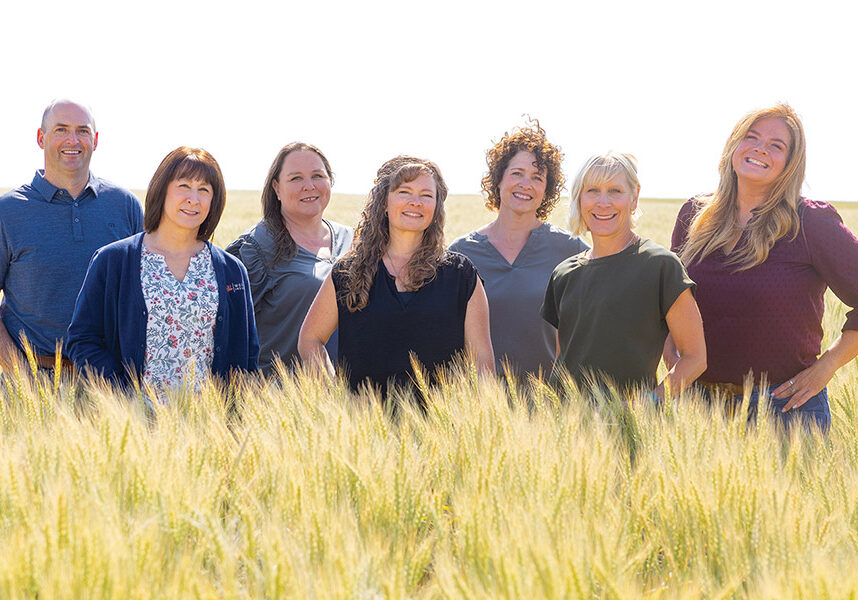
“I’m not biased, but we have the best team,” said Christy Harrison, a crop insurance agent who has worked for Western Insurance since 2017. “Our farm and crop team works really closely together.”
The other members of the farm and crop team include Jake Holling, Sherry Watkins, Tawnya Myers, Heidi Moffet, Mandi Braun, and Celeste McDonald.
Harrison herself didn’t come from a farming background. She began her journey into crop insurance in 2014 when she was hired as an underwriter for a Tri-Cities company. The new job came with a steep learning curve for the self-described city girl, but in the end, “ag came in and stole my heart,” she said with a laugh.
“Everybody says it takes three years to learn (crop insurance). The devil is in the details. There’s a lot of details in this program, a lot of deadlines. Every policy is different. It takes so much time because you’ve got to go through each growing season and see it from start to finish and see those cycles,” she explained.
Harrison describes crop insurance as having a lot more “service” work than other types of insurance. A crop insurance policy typically has three separate deadlines: the sales closing date, the production reporting date, and the acreage reporting date.
“Those are the three main deadlines, and every time, we’re touching our entire book of business. It’s almost like we’re renewing policies or having those annual reviews three times a year. It’s data entry; it’s a lot of numbers. It’s a lot of making sure acres are right, making sure the policy is set up correctly,” she said. “You’re putting in data, but you’re also looking at the policy as a whole to make sure it’s written right for that producer. Every farm’s so different.”
The U.S. Department of Agriculture’s Risk Management Agency oversees the administration of crop insurance, working with private-sector companies known as approved insurance providers, or AIPs, who sell and service the crop insurance policies. Crop insurance agents work closely with AIPs to stay informed of changes to existing products as well as learn about new products being made available to producers. Agents are not allowed to be involved in the loss process on something like a multiperil crop insurance policy. AIPs hire adjustors who go into the field to inspect or appraise a crop, usually when adjusting a claim.
Western Insurance has expanded far beyond its beginnings in Fairfield, but the company prides itself on retaining a sense of small-town service.
“I think that that’s our ‘special sauce.’ We’re all really connected with our clients. That’s really important to us, and as we grow, that’s just something that we’re not going to let go of,” Harrison said. “We love what we do. We love serving farmers and providing them risk management tools that can put their mind at ease. That’s our job, so we’ve got to take care of the people we serve. We don’t have jobs if we don’t have our farmers.”
Because crop insurance is such a critical part of a grower’s risk management strategy, Harrison said it is important to work with an agent that they trust and that they communicate well with. They also need to be diligent in reporting any farm and or crop changes to their agent. And crop insurance isn’t just for producers; landlords, especially those in a crop share agreement, need to make sure their portion of the crop is protected.
“We have so many different coverage levels, different plans of insurance (for landlords). It’s the job of a crop insurance agent to ask the client about their concerns and needs,” she said. “If they’re relying on this income to live off of, then they probably need to buy a higher coverage level, and they probably need to have that revenue side in addition to the yield side. It’s really important that we’re having those conversations.”
Last year, the company’s flagship office in Fairfield was sold, and they are looking for a new office in Spangle. More information about Western Insurance can be found at westerninsurance.com.