




Combatting Italian ryegrass New regional agronomist offers lessons from North Carolina research
2026March 2026
By Trista Crossley
Editor
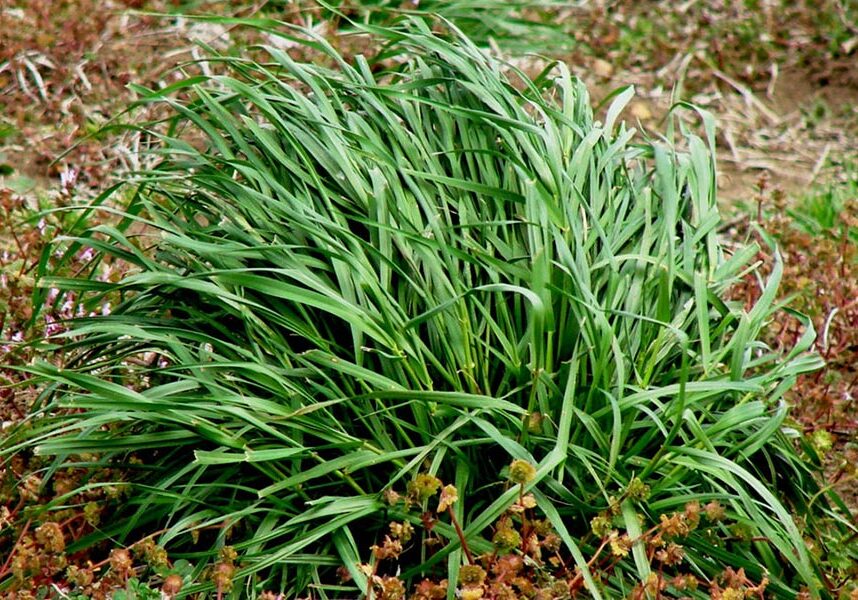
Cereal rye might not be the answer to Eastern Washington growers’ Italian ryegrass problem, but Morgan Menaker is hoping there might be a few lessons to be gleaned from his work in North Carolina with it.
Menaker is the new Washington State University Regional Extension agronomist covering Asotin, Columbia, Garfield, Walla Walla, and Whitman counties. He previously worked as a field crops Extension agent for North Carolina State University where he worked closely with growers on managing herbicide-resistant ryegrass. He was presenting to growers in January as part of the Agricultural Marketing and Management Organization’s 2026 winter schedule.

“Italian ryegrass is the exact same species here that we were dealing with on the East Coast. Some of the things that we were doing there, I think could translate here,” he said. “It’s an all-crops issue, not just a small grains issue.”
Morgan said most North Carolina growers are no-till, get 40+ inches of rain annually, and work with clay soils that are very prone to erosion, even on no-till ground. Growers there typical follow a two-year rotation: corn planted in the spring and harvested in the fall, followed by winter wheat harvested in June, immediately followed by double-cropped soybeans that are harvested in the fall. The ground is then left fallow over the winter.
“Here’s the rotation that I believe got us into a lot of trouble: winter wheat to soybeans to winter wheat to soybeans using the same grass herbicide in both crops,” Menaker explained. “It was nice to pay the bills and get those paychecks and keep landowners happy, but I think that is what gave rise to our group 1 and 2 resistance.”
Italian ryegrass has purple or reddish coloration at the base of its stem. The leaf blade is shiny and flat with ridgelike veins, and the seedhead is shiny, flat, and smooth with alternating seeds. In North Carolina, researchers have found that there are two biotypes: one that emerges in the fall and another that emerges in the spring. Italian ryegrass seeds can’t emerge from deep soil and has a high seed loss, offset with high seed production. On average, 60% of seeds shatter before wheat is harvested, and what’s left is easily spread by combine. It has known resistance to four sites of herbicide action. Research has shown that for every Italian ryegrass plant per square meter, growers are losing a third of a bushel of wheat.
Menaker said growers back east have tried using residuals, such as Anthem Flex or Valor; mechanically ripping the plants out of the ground using light discing or shallow tillage; or burning the plants down multiple times with “crazy” tank mixes. Research is showing some success with cover crops, specifically cereal rye, and fall residual herbicides.
“I don’t think we’re going to do this exact same thing here, but it worked for us there. Maybe it allows you guys to think outside the box and get a different perspective,” Menaker said. “Trying to navigate our way through this is going to take a lot of folks thinking together.”
Most of the North Carolina research has focused on a cereal rye variety called “Abruzzi,” which has some allelopathic properties that suppress germination of other plants. The cereal rye is terminated chemically before planting summer crops. The research found that all treatments that included cereal rye reduced the number of Italian ryegrass seeds. In fact, cereal rye alone controlled Italian ryegrass 85% and 61% at 24 weeks after planting at one location and 82% in another.
The next stage of the study explored planting date, seeding rate, and pre-emergent herbicide combinations, as well as fertilization rates for the production of cereal rye for hay and straw production. Menaker said key takeaways from that study included:
- Timely planted cereal rye outcompetes Italian ryegrass.
- Intense management of cereal rye provides superior suppression of ryegrass compared to minimal management. “Trying to just cheaply get a cover crop was not going to work, unfortunately, and we had to give it the Cadillac treatment of that residual as well.”
- Planting a forage variety of cereal rye, such as “Abruzzi,” may allow lower seeding rates and dual purpose as a forage.
“That’s just what we saw from year one. We’ll see if year two yields the same result,” Menaker said. “Could you move the needle economically and maybe stomach this sort of thing? That was what we were looking at. Growers had a lot of questions for getting this crop in and using it for a forage.”
In talking to Eastern Washington growers, Menaker said some of the things he’s hearing are:
- Growers are already using residuals.
- They are terminating field edges to stop Italian ryegrass from getting deeper into fields.
- They are using nonselective herbicides post-emergence in cash crop.
- They are tracking the size and location of “resistant weed islands” around the Pacific Northwest.
- They are already using some allelopathic crops in rotations, such as triticale and oats.
Growers with questions can reach Menaker at morgan.menaker@wsu.edu.