




Disease, pest pressure increasing After warm, wet winter, growers should be on the lookout
2026March 2026
By Trista Crossley
Editor
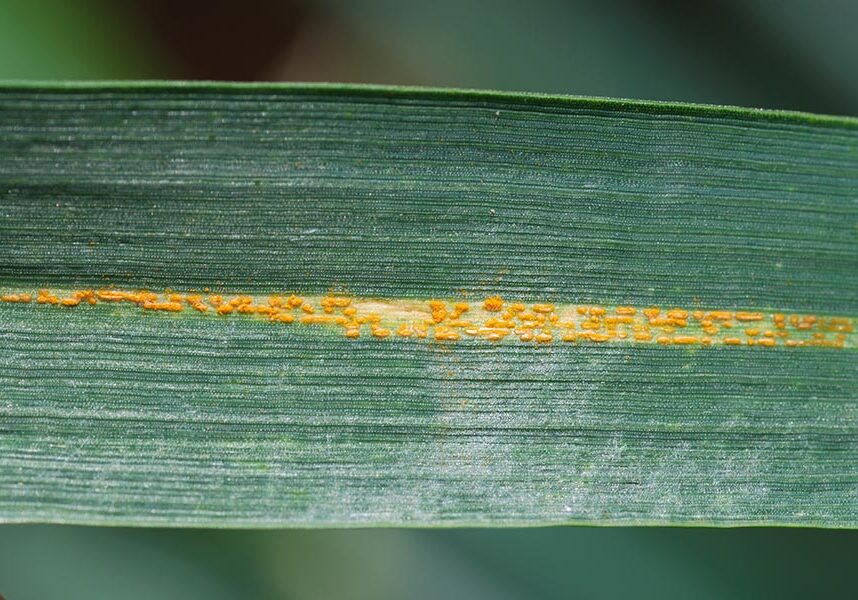
An unusually warm, wet winter appears to be increasing the pest and disease pressure Eastern Washington growers are facing going into spring, and at the top of the list is stripe rust.
According to the last update from the U.S. Department of Agriculture’s Agricultural Research Service research plant pathologist, Dr. Xianming Chen, stripe rust in the 2026 growing season is predicted to be in the upper range of severe epidemic level (40-60% yield loss on susceptible varieties).
“Stripe rust has been persistent across the region, and I’ve even heard reports of it in Whitman County, southwest of Pullman. We’re definitely seeing it, even on varieties that are rated very highly,” said Morgan Menaker, the Washington State University (WSU) regional Extension agronomist for Whitman, Asotin, Columbia, Garfield, and Walla Walla counties. For varieties that have high-temperature adult-plant (HTAP) resistance ratings, an initial infection is not uncommon, but any secondary cycle should be diminished as the HTAP takes over.
According to information from WSU Extension’s website, striperust.wsu.edu, the primary method for controlling stripe rust is to grow resistant varieties. Fungicide treatments can also be used to manage stripe rust, especially when growing moderately susceptible varieties.
Other control activities include managing volunteer wheat and grassy weeds that could serve as a source for overwintering fungi. Avoid early plantings as larger plants tend to intercept more stripe rust spores than smaller plants. Manage nutrients for expected yield potential and avoid overfertilization. Manage irrigation water to minimize the amount of time dew is present on leaves, which is required for infection.
WSU Extension agents are also getting reports that wheat grain mites are spreading in the Odessa, Wilbur, and Davenport areas. Mite damage may be mistaken as winter damage, due to yellowish leaves and stunted plants. In an alert published on the small grains website, smallgrains.wsu.edu/26mites/, WSU Extension agronomist Aaron Esser noted that the fields with heavy mite damage had a winter wheat, fallow, winter wheat rotation, while fields with winter canola, fallow, winter wheat rotations are showing little to no damage (as of mid-February). Because mites are more closely related to spiders than insects, most insecticides will not work.
“(Mite damage) almost looks like the damage you get if you went over a bunch of weak volunteers and sprayed them with glyphosate. It’s just yellowing out as that pest is a piercing, sucking insect,” Menaker added. “I would encourage folks, if they see damage like that, to look at our timely topic, because we do give recommendations for chemical control in there, things to look at, and learn more about that pest.”
Another pest that has reared its head in Walla Walla-Milton-Freewater winter wheat fields is spring Hessian fly. While the reports haven’t been officially confirmed, Menaker said the photos of damage he’s seen strongly indicate Hessian fly. The telltale sign of Hessian fly damage is randomly aborted tillers in small patches. After hatching, the worm crawls to the base of the plant stem and eats the stem tissue and leaf tissue, which causes the tiller to collapse.
“It wouldn’t surprise me, given that we did not have a very cold winter,” he said. “It’s alarming in seedling wheat because the damage can be really significant. Keep your ear to the ground. If it is Hessian fly, there will probably be a timely topic about it.”
There are also reports of army worms being found in the Lewiston-Clarkston area in south-facing canyons, specifically the yellow underwing moth.
If growers have questions or need to report a problem, they can email small.grains@wsu.edu or contact their local Extension office. Menaker said the small grains email is closely monitored, and messages generally get answered quickly. Growers can monitor smallgrains.wsu.edu for timely topics or subscribe to its mailing list.
Growers need to be aware of disease and pest cycles, and Menaker advised growers to start scouting their fields now as knowing is half the battle. In most cases, there is still time to impact some of these pests and diseases.
“The warm winter just let a lot of these things persist, whereas cooler, harder winters would probably have cleaned this stuff up,” he said. “I know folks may not be used to scouting their wheat this early in the year, but they need to get out and look. We’ve seen disease issues on winter peas, disease issues in wheat. We’re seeing pest pressure in wheat that is kind of uncommon. Things are occurring earlier than usual.”