







Following the identification of soilborne wheat mosaic virus (SWMV) in multiple locations in Whitman County earlier this year, Washington State University (WSU) Extension researchers have some encouraging updates for growers after harvesting and testing infected wheat stands.
“Our findings support the work that our previous pathologists did,” said Morgan Menaker, the WSU regional Extension agronomist for Whitman, Asotin, Columbia, Garfield, and Walla Walla counties. “We found susceptible varieties by themselves do show significant yield loss, but a susceptible variety blended with a moderately resistant or resistant line can essentially compensate for that yield loss.” See Figure 1.
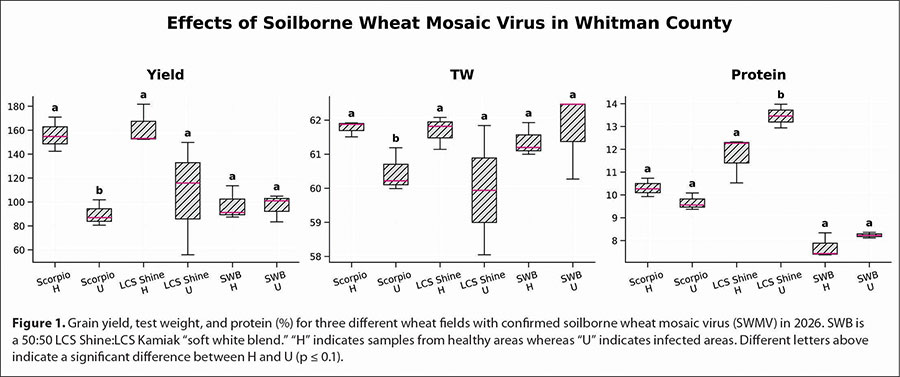
Menaker did find a significant difference in test weight in a hard red winter wheat sample, which he said could be attributed to the loss of overall performance.
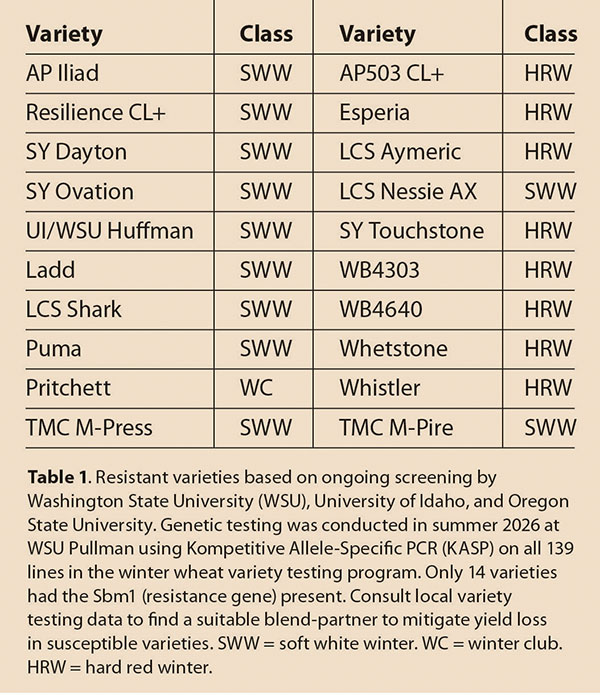
Over the summer, WSU wheat breeders and technicians inspected all 139 lines in the winter wheat variety testing program for the SWMV-resistant gene. Fourteen varieties have the gene present (see Table 1), although not all of those varieties are commercially available.
Because infected plants can appear to “grow out” of the virus and become healthy again, Menaker used GPS coordinates on three separate farms to pinpoint where in the field the virus was detected. He harvested multiple meter-square quadrants from known healthy and unhealthy areas in the same fields.
Menaker said there’s still no answer as to how the virus made the jump to Whitman County north from the Walla Walla Valley or west from Nez Perce and Idaho counties in Idaho. Some theories include infected soil being moved by wind or migrating birds.
“In my lines of questioning, there was never like any red flag, like a new agronomist, a new piece of equipment, or a custom spray or seeding applicator doing work,” he said. “We’re scratching our heads trying to figure out how (the virus) makes these big jumps.”
SWMV is vectored by a parasitic, fungus-like protist, Polymyxa graminis, that infects the roots via motile swimming spores. The protist forms resting spores that can survive in the soil for many years. It requires free moisture to infect, and that is why symptoms are usually found in plants in low-lying areas with wet soil. Timely tissue sampling and testing are the only forms of confirmation. Testing is not as effective as plants age. Infected plants exhibit splotchy leaves with green, yellow, and sometimes red or purple discoloration. Streaks are parallel to leaf veins. Infected plants have fewer tillers than healthy plants, and SWMV is associated with significant losses in yield (40%), biomass, (37%), and heads (34%) in the Pacific Northwest. Once the virus is present in the soil, the only treatment is to plant or blend resistant varieties.
Winter wheat is most suspectable, but spring wheat can also be affected, depending on when it is planted — the drier the planting conditions, the less risk there is.
Menaker said the three land-grant universities in Washington, Oregon, and Idaho are working together on a SWMV nursery to confirm resistance genes and do field screenings to generate severity ratings. He encouraged growers to be on the lookout when winter wheat breaks dormancy and starts to green up in the spring. If they see a “weird yellow patch,” they should contact their local Extension office and get samples DNA tested. WSU Extension will be publishing more information on SWMV at smallgrains.wsu.edu in the near future.
“I think that growers have enough information to take action and make the proper blends if they need to and not give up any sort of yield,” Menaker said.