




Finding common ground Ad and Water Quality Committee brings diverse groups, Ecology to the table
2026January 2026
By Trista Crossley
Editor
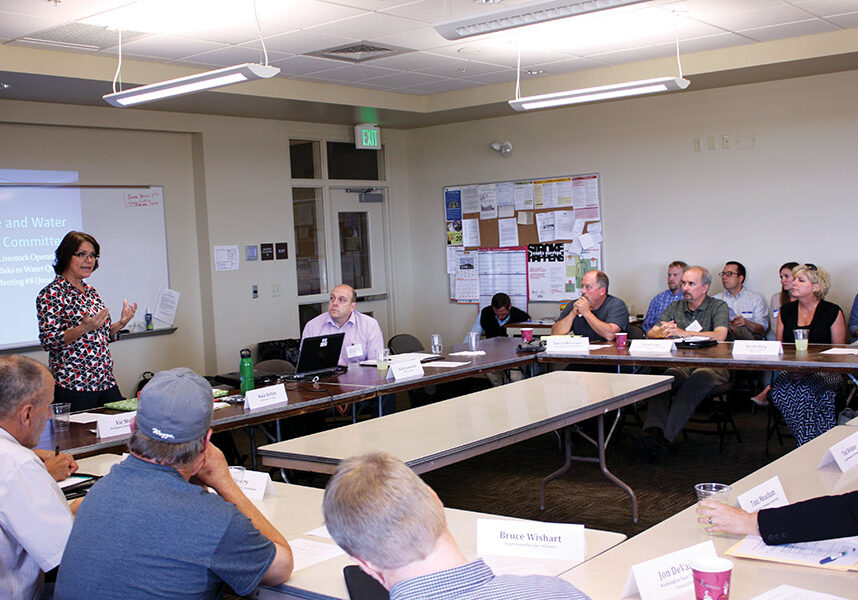
In an attempt to clear the air over agriculture and water quality, the Washington State Department of Ecology (Ecology) convened the first meeting of the Ag and Water Quality Advisory Committee in March 2014 under then-director Maia Bellon. More than 10 years and three directors later, the committee is still going strong.
From the beginning, wheat growers were strong participants in the group. Nicole Berg, a grower from Benton County and a past president of the Washington Association of Wheat Growers (WAWG), said the idea for the committee may have gotten planted during a conversation between herself and Bellon at a time when growers were particularly frustrated with Ecology’s methods.
“Director Bellon and I were in the back of a car on a tour, and she was asking how to get agriculture to have a conversation,” Berg said. “I basically told her she needed to set the table with growers in the room, because when growers get in the room, they will help problem solve. That’s exactly what she did. She created the ag and water quality group with the idea of having a statewide conversation with regards to ag and water quality that’s solution oriented and not just farmers and Ecology battling each other.”
Larry Cochran, a wheat grower from Whitman County and another past president of WAWG, has been involved in the committee from the beginning. He remembered being optimistic that if growers could hear what Ecology’s concerns and plans were, agriculture could understand where the department was coming from and provide feedback.
“I didn’t know whether it would make a difference or not, but like everything else, if we didn’t try, we knew we wouldn’t make a difference,” he said.
Heather Bartlett, Ecology’s deputy director, has also been involved in the group from the beginning. In 2014, she was leading Ecology’s water quality program and recalled that period as a “very tense time,” especially between the department and the livestock industry. Just a year earlier, the state Supreme Court had ruled in favor of Ecology in the Joe Lemire case, saying Ecology was not required to rule out other sources of pollution in a nearby creek; they only had to prove that the conditions in the creek were consistent with cattle having unrestricted access to it.
“Director Bellon really wanted to forge relationships that would give us the opportunity to find common ground, where we could learn from the ag industry, and we would no longer be kind of nameless, faceless, regulatory bureaucrats. We’d be people seeking to find solutions that worked in our watersheds, for agriculture and for clean water,” Bartlett said.
The stated aim of the group was to provide an open forum for dialogue ensuring both water quality protection and a healthy agricultural industry. Bartlett believes the group has achieved that goal, finding solutions that work for the department to achieve water quality that have not come at the expense of agriculture, such as how the department identified a potential problem, how the department contacted landowners, and how they’ve communicated with landowners. Bartlett said the group was critical of the way Ecology had been contacting landowners and gave suggestions that were later incorporated into the department’s communications.
“We had spent a lot of time in technical assistance, trying to share information with the landowner, but what was happening early on is the way in which we were saying things or the way in which we were approaching it immediately put a landowner on the defense,” she explained. “That’s not a good a posture for coming up with solutions or talking through options. The committee really shaped how we wrote our letters. They informed how we went about our work.”
The committee also shaped how Ecology approaches nonpoint pollution work. They recommended that when an issue was identified, the department needed to be more consistent in how and when they approach a landowner. They also recommended focusing on one watershed at a time, rather than multiple watersheds all at once.
Another success the committee has had a hand in that Bartlett pointed to were commodity buffers and working with conservation districts to put in riparian buffers that protect water quality and help offset crop loss.
Since the Lemire case put a spotlight on “substantial potential to pollute,” defining what that actually means has been an ongoing issue the group has tried to address.
“The potential to pollute that’s in the RCW is one of the things that we’ve always battled,” Berg noted. The RCW, or the Revised Code of Washington, is the official, organized collection of all permanent laws currently in force in the state. “What’s the definition of ‘potential?’ I think we’ve kept that at bay, because we can communicate what is actually happening on the farm and that we don’t run out and try to farm with a potential to pollute.”
The latest director of Ecology, Casey Sixkiller, was appointed by Gov. Bob Ferguson in 2025. While the committee has met less frequently in later years, Sixkiller has expressed interest in continuing the committee and possibly expanding its focus, which has raised some concerns among ag stakeholders. Bartlett said that expanded focus might include talking about greenhouse gas emissions and dairy digesters as well as adjudication issues.
“I think we’re in that transition place of how to hold that water quality priority while also providing a forum in which we can have these open conversations about other places that Ecology has a nexus with agriculture,” she said. “I think that’s the balance that we’re trying to find right now, because it is important while also creating some space in a regular forum that meets with Director Sixkiller to talk about other things that might have an Ecology component.”
Neither Berg nor Cochran are opposed to expanding the committee’s focus, reasoning that the more ag is involved in Ecology’s work, the better.
“Water rights are becoming a big issue in this state. Water adjudication is something they (Ecology) want to look at,” Cochran said. “There’s a lot of things out there that we probably need to understand. Whatcom County is doing their water adjudication, and, basically, the water is already overallocated. That’s going to be coming more and more around the state. If I can help Ecology figure out how to save water, and we can work together, that’s a good thing.”
Berg feels it is important that the group meets at least quarterly (in 2025, the group only met once) and works on creating measurable goals with follow through.
“It’s important that we keep that voice of agriculture speaking to the regulatory authorities, especially in the state of Washington,” she added.
The committee has also been influential in helping Ecology develop its voluntary clean water guidance. Bartlett said the members stressed the importance of including researchers, applied researchers, and conservation districts in the work. Especially important to the committee was forming a workgroup that looked at the actual implementation of the best management practices (BMPs) that the department would be recommending.
“We did that. I think that has been really important for the utility,” she said. “We didn’t want to develop something that sat on a shelf and was never useful to conservation districts and landowners. We wanted something that was practical, that people could feel had been proofed out, so to speak. Not just proofed out in research, but proofed out on the ground. This committee was instrumental in that.”