




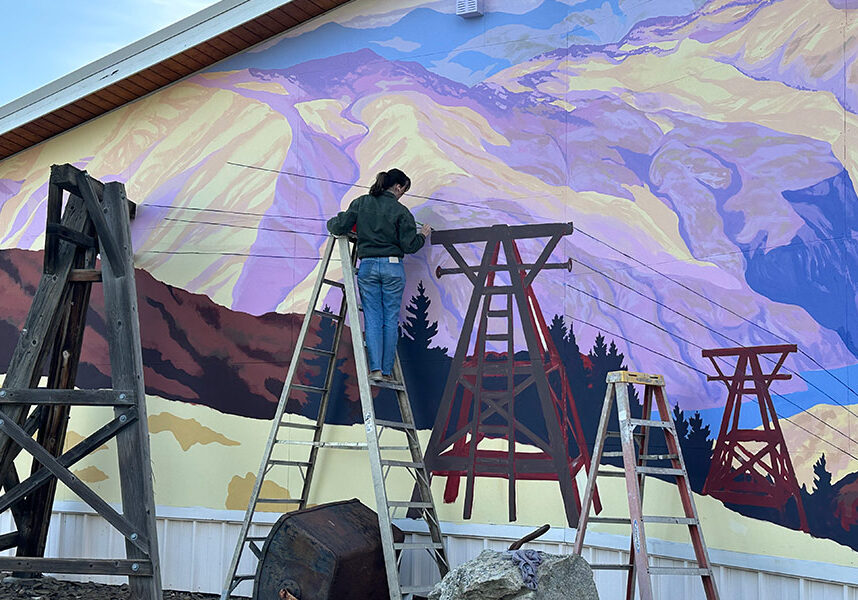
Like the early 1900s aerial tramway it depicted, a 30-year-old mural on the side of the Douglas County Museum in Waterville, Wash., was in danger of fading into obscurity. But over the past summer, it got more than just a facelift, thanks to local artist Don Nutt.
“The mural had deteriorated to a point where it was almost impossible to see it, and so the Douglas County Museum board of directors first asked if I would just repaint it,” Nutt said. Nutt owns Cariboo Trail Studio in Coulee City, Wash. “Well, there wasn’t enough image up, and we had to replace the substrate. There’s no reason to paint on boards that are going to pull apart, so I told them I didn’t want to repaint another artist’s work. I told them I would do my own interpretation of it, so that’s what I did.”
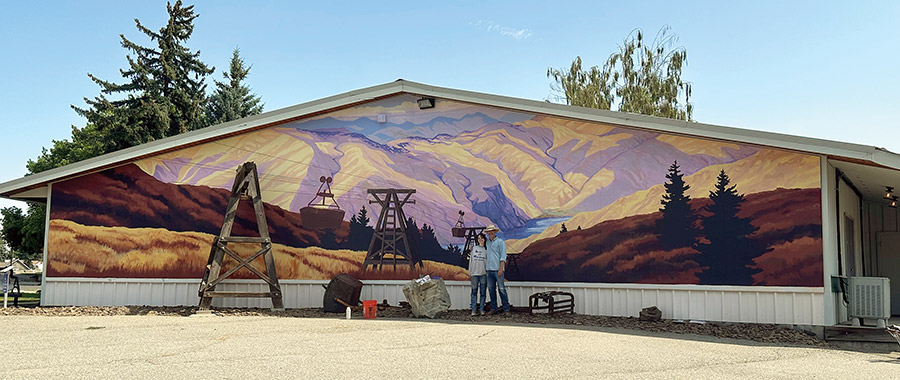
The 60-foot-long mural celebrates an integral part of the region’s agricultural history. Beginning in 1902, an aerial tram located north of Orondo carried sacks of wheat from the plateau 2 miles down the bluffs to the Columbia River, crossing several canyons along the way. At the river, grain was loaded into steamboats and shipped to the Great Northern railroad in Wenatchee. According to newspaper articles from the time, the tram had the capacity to move 12-15 tons of cargo per hour and cost between $25,000 and $30,000 to build.
The tram seemed to be successful. A December 1907 excerpt from a local paper said, “There is over 200,000 bushels of wheat now piled up at the Tram awaiting shipment. It is being sent out as fast as the boats can carry it. Wheat is coming to the Tram from 30 miles away. The roads to the river are not good for sleighing, and it is fine to the Tram, hence they haul there. If it were not for the Tram, at present, the farmers would be up against a hard proposition to get off their wheat crop.”
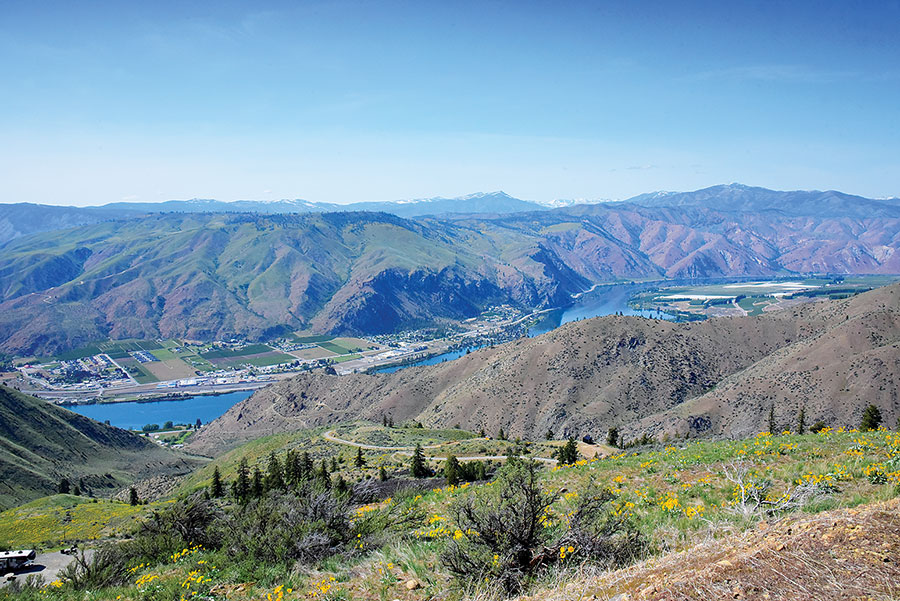
The tram became obsolete in 1910 when a branch line of the Great Northern was built to Mansfield. In the intervening years, the structure has fallen victim to fire, weather, and scrap metal collectors, leaving very little evidence behind. When Nutt got the commission to repaint the mural, the first thing he did was a little historical research. The next step was seeing how the tram might have fit into the landscape. He and a friend got permission to visit the site of the tram, which is mostly on private ground, and used a drone to take aerial photos of the area.
“We knew where the top of the tram was, and we knew where it came to the river, more or less, but it was unusual, because it had to cross a couple of smaller ravines on its way down. There were a lot of questions I had about exactly how this would look,” Nutt said.
One of the structures that helped hold up the cables was part of the original mural and was staying. Nutt had to take that into account.
“From an artist’s point of view, there’s so many options. I’ve got this giant canvas,” he said. “I thought it would be cool to show them loading sacks of wheat on a steamship and have the tram going up the hill, from that perspective. But (the museum) didn’t want to take that truss out of there, so that really limited what I could do.”
Armed with photos and research, Nutt did two different to-scale paintings for the museum board to choose from. Once the choice was made, Nutt and his assistant, Emma Buchanan, got to work. The first thing they did was replace the substrate. Once the surface was ready, they used chalk lines to establish a grid, and then the painting commenced. It took about nine days to actually paint the mural, using house paint with a UV coating over top.
Nutt hopes the new mural, which faces Highway 2, gets people intrigued enough to stop at the museum and ask questions. He said he was surprised by how few people knew about the tram.
“The old mural had been there for so long, and, of course, it had faded. It was well past the point of being a mural. Thirty years is a lot to ask of anything. It just kind of become part of the scenery, and I don’t think people in Waterville really noticed it very much anymore,” he said. “I was surprised at how many people stopped by and asked, ‘What is this thing you’re painting? Is that the ski hill? Is that a ski lift or something?’ It was kind of surprising how few people really knew what it was and knew about the history. I think it’s good for the community to know this thing happened here, you know?”
More information about Nutt and his work is at caribootrailstudio.com. Information about the Douglas County Museum and the tram is at douglascountymuseum.com.