




It can be hard to find stability in today’s topsy-turvy ag economy, but an accurate balance sheet could make all the difference.
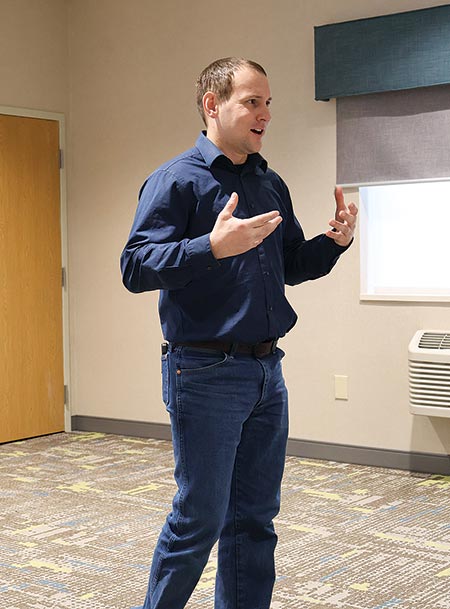
That was the message growers heard in January at a workshop focused on “The Business of Farming,” presented by Jon Paul Driver. Driver is an ag economist with a background in ag risk management. He is a Washington State University (WSU) Extension economics specialist and is the founder and host of Hay Kings, a podcast and producer network of more than 90,000 members. He was presenting to growers as part of the Agricultural Marketing and Management Organization’s 2026 winter schedule.
“I want you to take away that these are communication tools that demonstrate your capacity to survive in agriculture,” Driver said. “One of my mantras is it’s never just a bad year that takes down a farm. It’s a bad year and something else. The strategy is to use cash flow and asset management to build a buffer for the ‘something else.’”
That something else could be a death or a divorce, insurance errors, worker injuries, or relationship strain during financial stress.
Driver said most growers will likely have multiple balance sheets for multiple entities. Growers need to inventory assets and liabilities, and those inventories should be updated regularly.
Assets
Driver said most producers can’t provide a current, itemized list of assets. A grower’s asset list should be used for accurate reporting on personal property taxes, proper insurance coverage, and internal management.
“If you don’t build it (the asset list), you don’t understand it,” he said. “You lose the ability to perform your own financial analysis. These records are for us first, then insurance, and then bankers.”
Assets are broken down into three categories: short term, intermediate term, and long term. The biggest long-term asset is land. Driver recommended listing all parcels, leased and owned, on a spreadsheet (“It doesn’t cost anything extra to list them all”) and include information such as the name the grower uses, landowner’s name, lease details, mailing address, phone number, and legal description. Growers should audit this information annually to make sure details are correct. Buildings will generally be valued with property and should also be evaluated annually. Growers may even have different balance sheets based on cost basis and market value that they can use to do some stress testing.
Equipment is an intermediate-term asset. Driver suggested growers do an equipment audit and list make, model, serial number, hours, acres, and miles and then compare that to their insurance list. He also suggested that growers ensure that VIN numbers match on insurance and lender paperwork.
“If the values are coming down, that’s lower premiums. If your replacement costs are truly lower, that could be lower premiums,” he explained. “You’re going to find something on your insurance agent’s list that you got rid of a long time ago, that you’ve been paying for the whole time.”
Current assets include investments made in a growing crop, consumables, and products for sale.
“If you haven’t previously inventoried fuel and pesticides and fertilizer as part of your balance sheet, that’s a note that you need to make. Those things should absolutely be on your balance sheet as a short-term asset,” Driver said.
Liabilities
Growers need to understand what they owe to protect what they own. Like assets, liabilities are broken down into current, intermediate term, and long term. Current liabilities are things growers are going to convert to cash in the next 12 months. They represent the immediate pressure on cash flow, such as operating loans, internal loans between business entities, accounts payable, and the current portion of long-term debt.
Intermediate liabilities are due over one to 10 years. These usually track alongside the life of equipment or livestock and include machinery and equipment loans, debt taken to expand livestock herds, and vehicle loans.
Long-term liabilities are usually due beyond 10 years. These are often the biggest burdens of an operation and include real estate mortgages, land contracts, and loans for buildings and improvements.
The balance sheet
“So now, as we think about the balance sheet that we have in front of us, we’ve looked at assets and liabilities — current portion, intermediate term, and long term. What do we do with it? The most basic use of this is to figure out our equity. If we take our assets and subtract out our liabilities, what we have, what we own, versus what we owe, the difference is equity,” Driver said. “This is really important why we have at least an annual update. Do it consistently. If you find that you’re in some financial trouble, update it every six months, then you start to add granularity to that data.”
The first thing lenders tend to look at on a balance sheet is the total debt-to-asset ratio. A ratio under 30% is considered strong. Over 60% is usually a red flag for a bank.
Liquidity, or cash flow, is another thing banks will be looking for. That value is found by dividing current assets by current liabilities. A ratio of 2 or higher is considered strong. Growers below a ratio of 1.1 could be left short on cash if something goes badly.
Cash flow
Driver likes to start new farmers out with the IRS Schedule F form that lists some standard categories for income and expenses and asks users to allocate amounts each month.
“The whole point for cash flow management is not running out of money, because that’s actually how your farm ends,” he said. “It’s not an asset problem. It’s a cash flow problem in every single liquidation ever. The only way to avoid a cash flow crisis is to plan ahead.”
Growers should be trending some items over time, like insurance costs, repairs, and maintenance.
“That’s absolutely something we can manage and have control over. It’s one of the bigger levers we can pull on to change the outcome,” he explained. He also suggested leaving ad hoc government payments out of cash flow planning.
At some point during the year, growers will usually find that their cash flow plan is wrong. Despite making growers feel “the worst,” Driver said it’s actually a great learning opportunity.
“Plan, do the things, and figure out why you were wrong. That figuring out why you were wrong is the most valuable part of all of this,” he said.
As part of his WSU Extension role, Driver does one-on-one farm management planning across Eastern Washington. He can be reached at jonpaul_d@wsu.edu.