


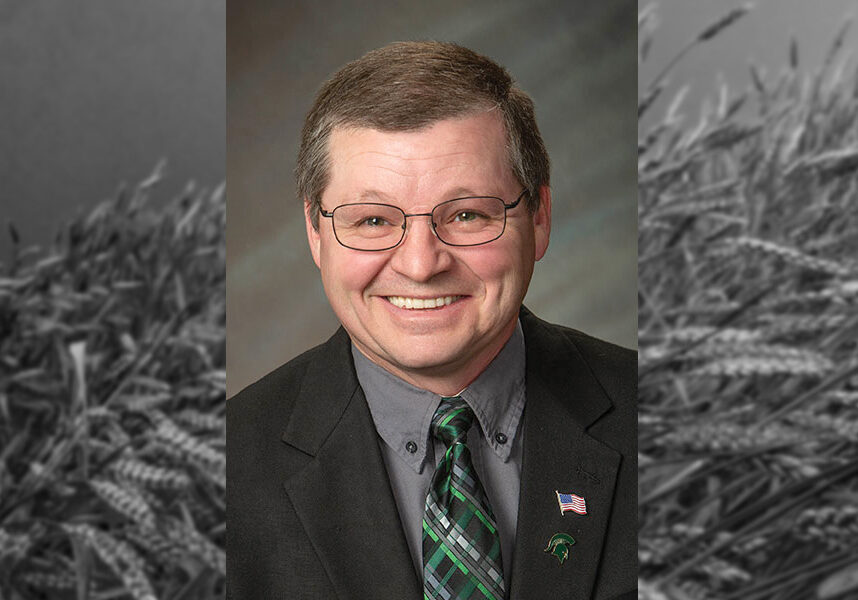
The 2026 Agricultural Marketing and Management Organization’s (AMMO) Wheat College will be held June 2, in Colfax, Wash., at the Palouse Empire Fairgrounds. The keynote speaker will be Dennis Pennington, a wheat systems specialist at Michigan State University (MSU). His presentation is titled, “Stacking the Bushels: Small Decisions, Big Yield.”
This annual event will offer a mix of indoor and outdoor presentations. Registration begins at 9 a.m. with the Graybeal Group sponsoring coffee and doughnuts. Admission to Wheat College is free, and lunch is included. Growers do not have to be member of the Washington Association of Wheat Growers (WAWG) to attend. Growers are asked to RSVP at wawg.org/ammo-workshops/, email kgilkey@wawg.org, or call (509) 659-0610. Growers who RSVP by May 29 will be entered in multiple prize drawings.
Besides Pennington, Wheat College presentations will also include:
- Soilbourne Wheat Mosaic Virus: Know the Signs and Symptoms featuring WSU Extension Regional Agronomist Morgan Menaker.
- WSU’s Amber Hauvermale and Alison Thompson will give updates on falling numbers and talk about tools to help manage the problem.
- Getting Land Back into Production After CRP. Do you have land that is currently in the Conservation Reserve Program (CRP) or recently have had land come out of CRP that you want to put back into production? This presentation helps explain your next steps, and how to put your land back into production. Presented by Mitch Ruchert from the Natural Resources Conservation Service (NRCS).
- Soil Health Demonstration – Rainfall Simulator. NRCS will have their Soil Health Trailer on site and will be providing presentations of their Rainfall Simulator to demonstrate the effects of rain on different types of soil. The presentation demonstrates the characteristics of healthy soil and the importance of cover crops. Presented by Stephen Johnson.
“Wheat College is one of our most popular AMMO offerings, and I think we’ve raised the bar this year by bringing Dennis out to speak to our growers,” said KayDee Gilkey, WAWG’s outreach coordinator. “Besides the educational value of Wheat College, it’s also a fantastic opportunity to network with other growers.”
Data-driven decisions
Pennington has been employed with MSU Extension for 29 years. He received both his Bachelor and Master of Science degrees in MSU’s Crop and Soil Sciences Department. His current research program includes the wheat state variety performance trials, precision planting, high yield management project, and the Great Lakes Yield Enhancement Network (YEN). The Michigan Wheat Program farmer checkoff funds 50% of his position in partnership with MSU. He is based out of the Mason Research Farm southeast of Lansing, Mich.
Besides sharing some of the findings from the Great Lakes YEN, Pennington will also talk about wheat phenology, growth, and development and how management interacts with different yield components. Crop nutrition, disease management, and fungicide applications will also be discussed.
“We collect a lot of data in the YEN program, so my plan is to share some of that with the group and show how we use it to support decision-making on the farm,” Pennington explained. “That decision-making process is something I want to spend some time on, because having access to data on how a crop grows and responds to its environment is essential for improving yields.
“I often hear growers say they don’t have time to run on-farm trials, but I want to challenge that thinking. If you don’t have time to try new things, how will you achieve higher yields? If you keep doing the same thing, why would you expect a different outcome?”
Pennington also plans to engage growers through live troubleshooting, using real farm data to walk the group through the process of developing at least three agronomic recommendations for a given operation.
“The goal is to get them thinking more broadly, not just about the value of data, but about wheat agronomy as a whole, including crop growth, development, and management, and how all those pieces fit together to drive yield,” he said. “It’s about using the information they have to make informed decisions about what they can change or improve on their own farms.
“I want the group to ask questions. Interactive discussion is a big part of that, because it helps put the pieces together. Sometimes those conversations go off script, but that’s okay, as long as we’re learning together. There are a few key things I want to cover, but I also want to dig into the topics that matter most to them.”
Great Lakes YEN
The Great Lakes YEN has come up at previous Wheat Colleges. Pennington has been involved from the YEN’s beginning in 2021, when it was started by the Michigan Wheat Board and the Grain Farmers of Ontario. Grower data is collected throughout the year and compiled into reports (both group and individual) that growers can use to fine-tune their operations. Pennington said the ability to create a network of growers that allows them to share ideas and data with each other was what got him excited about being part of the Great Lakes YEN.
“Out of all of the Extension programs I’ve done over my 20-plus years, this has probably been the one that’s been the most farmer-driven and the most exciting for me to be part of because of that focus on ways that we can help farmers improve yields,” he said. The Great Lakes YEN is in its sixth year and now includes over 600 site years of data. “We have all of this data from all these different environments, which is powerful to summarize and try to glean learnings from.”
The report that YEN participants receive include about 60 data points with comparisons to group averages. Pennington is hoping to spend a few extra days in Eastern Washington to visit some farms (and possibly explore the idea of setting up a YEN here).
There is currently one grower in Eastern Washington who is participating in the Great Lakes YEN — Jesse Brunner in Lincoln County.
“What would be ideal is we get 30 or 40 growers in it. And then we can group their data together so that you’re only comparing Washington growers with each other,” Pennington said. “If you’ve only got three or four growers, it’s going to take a long time before you build much of a database. I would love to see if there’s interest in it by the growers.”
AMMO sponsors
The 2026 Agricultural Marketing and Management Organization schedule, including Wheat College, is possible with the generous support of these sponsors:
AgWest Farm Credit
Almota Grain
HighLine Grain Growers
JW & Associates, PLLC
Leffel, Otis & Warwick
Northwest Grain Growers
Patton & Associates LLC
PNW Farmers Cooperative
Ritzville Warehouse Co.
The McGregor Company