





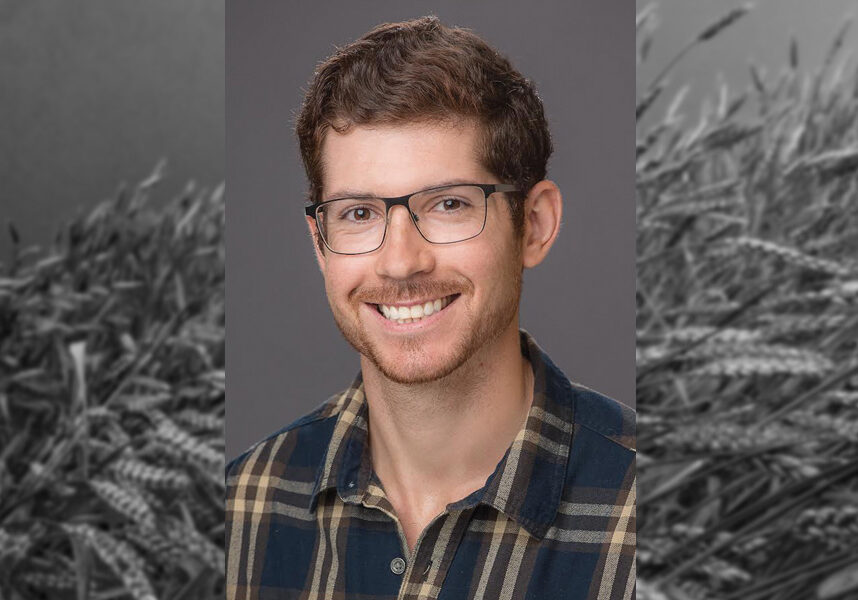
Coming from a region of rolling hills where soft red wheat dominates and annual rainfall averages 45 inches, Morgan Menaker admits he experienced some culture shock upon arriving in Eastern Washington.
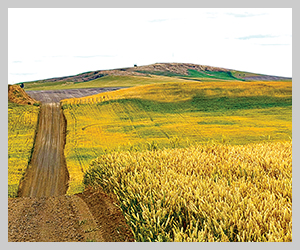
“The first time I came to Pullman for my in-person interview, driving south of Spokane into Whitman County was almost like arriving on another planet,” Menaker said. “The beautiful green wheat fields in May seemed to stretch on forever. I had never seen images of the Palouse country. It was truly eye-opening.”
Menaker began his new role with Washington State University (WSU) Cooperative Extension in September 2025. Based in Colfax, he now serves growers across Whitman, Asotin, Columbia, Garfield, and Walla Walla counties.
Menaker moved from North Carolina, where his average farmer managed 2,000-3,000 acres, to Eastern Washington. He previously worked in Union County, N.C., one of the state’s top agricultural counties where crops include soft red wheat, corn, sorghum, cotton, fruits, and vegetables, alongside numerous horse, goat, and cattle operations.
“Most people have eaten soft red wheat; they just didn’t know it. When you look at the back of a six pack of Lance Crackers, it’ll be from Charlotte, N.C.”
Menaker’s interest in agriculture and plant biology began early. His grandfather and father owned a Christmas tree farm in the Appalachian Mountains when Menaker was young. He earned a degree in general biology from the Virginia Military Institute (VMI) in 2017 and a master’s in plant science and pest management from Virginia Tech in 2022. At VMI, cadets live in barracks all four years as members in the Corps of Cadets.
Following graduation, Menaker served in the U.S. Army under a three-year contract and completed Armor Officer Basic at Fort Benning, Ga. He served with the 4th Squadron, 3d Cavalry Regiment in Fort Hood, Texas. Menaker served in heavy weapons then reconnaissance troop. He also rotated through South Korea.
“I enjoyed my time in the Army,” Menaker said, “but I decided not to make it a career when my contract ended.”
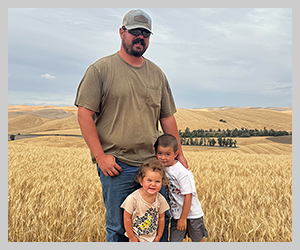
During his military service, Menaker married his wife, Kirsty. The couple now has two children: a four-year-old son and one-year-old daughter. After leaving the military, Menaker worked with Metrolina Greenhouses in Huntersville, N.C., focusing on plant propagation.
“I enjoyed the work,” he said, “but I missed the service aspect. Serving and helping others has always been important to me.”
That desire to serve led him to Extension work. He initially worked with nursery operators and fruit and vegetable growers before transferring to Union County, where small grains and soybeans are major crops. His Extension program focused on producing milling quality wheat and weed control.
One of the primary challenges there was managing pests and diseases. Another was managing herbicide-resistant weeds, particularly multiple resistant Italian ryegrass. A typical rotation in his region included three crops over two years with no summer fallow: spring corn harvested in September; winter wheat planted immediately after and harvested by early summer; followed by soybeans harvested before winter. Corn would then be planted again the following spring.
“There was never any summer fallow, or you’d end up with a field full of pigweed or ryegrass,” Menaker said. “It was a remarkable and rewarding experience to provide critical research to growers in the area where I grew up.”
Because of intensive rotation patterns and widespread use of herbicide-tolerant crops, Menaker notes that North Carolina may have been 15–20 years ahead of the Pacific Northwest in developing that level of herbicide-resistant weeds. He conducted extensive research addressing resistance issues in wheat and other crops during his three years in Union County.
When the opportunity arose to join WSU Extension, Menaker welcomed the challenge.
“Here in Washington, we’re dealing with herbicide resistance in cheatgrass, Italian ryegrass, morning glory, Russian thistle, kochia, and other weeds,” he said. “I’m eager to work with local growers to find practical, long-term solutions.”
Menaker has submitted research funding requests to the Washington Grain Commission and the Washington Oilseed Commission to support work on herbicide resistance management. Potential solutions include diversified crop rotations and adjustments to standard herbicide programs.
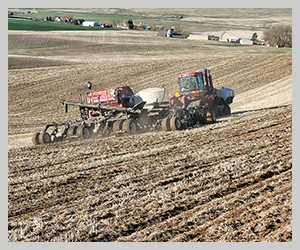
“As we all know, change doesn’t come easily,” he said. “Conservation practices, direct seeding, and precision agriculture technologies all require investment. The payoff is there, but it takes time to recover those costs.”
He compares reliance on chemical management practices year after year to running on a treadmill — steady effort without forward progress. As one University of Idaho scientist put it, “We sprayed our way into this problem; we’re not going to spray our way out of it.”
Menaker strongly believes in on-farm research and is already planning trials throughout his five-county region. He would like all projects to include at least two sites, accounting for soil type variability and differing precipitation.
“My work focuses on research that local growers want and what will benefit them most,” he said.
He encourages wheat growers to plant multiple varieties rather than relying on one. Planting only one variety can increase vulnerability to winter injury or disease outbreaks.
“I’ve encountered some minor skepticism about my background not being in soft white wheat,” Menaker said, “but I believe things are progressing well. I look forward to continuing to expand my knowledge and serve our growers.
For Menaker, the most rewarding part of the job is making a tangible difference.
“I enjoy the research side of my work,” he said, “and I love that it directly supports our local growers.”
Outside of work, Menaker enjoys spending time with his family and exploring the Pacific Northwest. He can be reached at his WSU Cooperative Extension office at morgan.menaker@wsu.edu or at (509) 397-6290.