





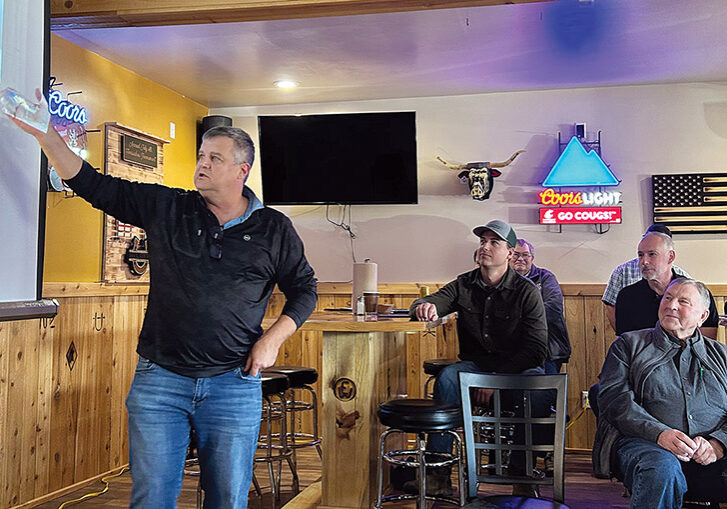
Financial presentations are usually popular with growers, but adding fried chicken and jojos from Sonny’s Tavern in Washtucna made February’s Agricultural Marketing and Management Organization’s (AMMO) seminar a slam dunk.
Before getting to the victuals, growers heard about estate planning from Corey Brock, financial advice from Tara Wiswall, and an estate tax update from Jared King.
Estate planning
Brock, an attorney with Brock Law Firm, dove into estate planning. These are highly emotional assets that are moving from generation to generation, and families need to decide what legacy means and work with a team that understands agriculture.
“Is the farm the legacy or the family? Hopefully, it can be both,” Brock said.
There’s a huge difference between fair market value and farm value, and it’s one of the biggest issues Brock works with, especially when there are nonfarm kids in the picture. He cautioned growers to be aware that kids may not have the same kind of emotional attachment to the farm as the parents do, and the next generation has to know what is going on.
Typical estate planning goals for farm families include:
- Keeping the farm in family.
- Designating specific heirs to operate.
- Being fair to other children and/or off farm children; however fair doesn’t necessarily mean equal.
- Having a realistic cash flow. One common scenario that Brock runs into is mom and dad just got debt paid off at age 75. Kid wants to come back, but can the farm support them all? Then, a neighbor’s farm comes up for sale, and instead of retiring, the parents have to figure out how to pay back that new debt.
- Have a practical plan. There’s a lot of bad lawyering, and if you aren’t working with people who have experience in agriculture, you are doing yourself a disservice. Law has become very specialized.
“The goal is how do we transition this and make it work? If you only transition it at death, it won’t work. At 45, if your kid doesn’t have a substantial stake in the farm, they are just a hired hand,” Brock said. “A silent will will fail. Mom and dad knew what they wanted, but they didn’t tell anybody. Don’t punt it to the next generation. Make the hard decisions for the family and the next generation.”
Farmers need to evaluate their estate plan, which should be structured for three things:
- Asset protection. Farmers are both landlords and tenants. They need to separate out land (the passive side) and the operation (the active side) into different entities. This helps protect the land from potential legal actions.
- Tax planning. Your plan needs to be structured properly for both income and estate taxes by a qualified firm that has lots of experience with ag. As a self-employed person, growers should take a careful look at the social security tax as there are ways to save on that.
- Transition planning. Growers shouldn’t put nonfarm kids with farm kids on the operating side; those entities should be transitioned differently.
Brock walked growers through an example of a family with three kids — a son who farms and two off-farm daughters — and how he’d structure the farm. The goals include minimizing taxes; providing for succession planning; protecting income to mom and dad; providing safeguards from divorce, bankruptcy and nonapproved transfers (nonlinear heirs); and maintaining control to mom and dad and then to their children. The land would be placed in an LLC and the operating side in a partnership with separate corporations for the parents and the children. The son would be able to buy out the sisters at farm value, not fair market value.
“Talk to your kids and make sure off farm family are taken into consideration and given value. Most of them probably want the cash. The best way to keep the farm together is to keep the farming kid as owner of the land,” he said.
Brock’s key takeaways were:
- Identify a business structure that works for the business, not only for estate planning.
- Communicate early and often.
- Give cash to uninterested family members early with clear understanding that the farm assets will remain with the farm family members.
- Balance accumulating assets personally (for retirement) while keeping the business cash flow healthy.
Sound financial advice
Wiswall is a financial advisor with Edward Jones who’s seen what the lack of proper planning can do to a family farm. One side of her family lost their farm when the farming sibling couldn’t afford to buy the other siblings out without having to sell the farm. On the other side, her grandfather retained control until he was 80 years old and was diagnosed with cancer. When he was forced to give up control, none of his heirs had an interest in coming back to the farm.
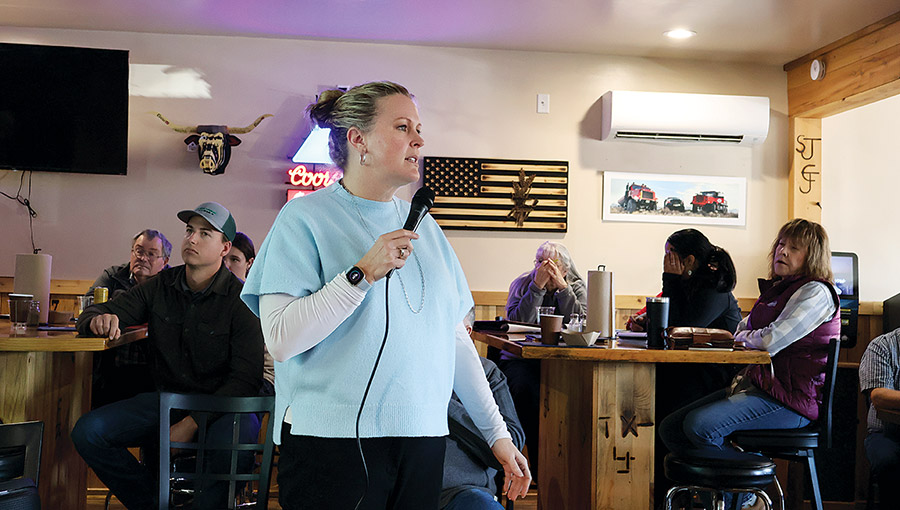
She encouraged growers to involve family members in all farm activities to promote teamwork and enhance cooperation and efficiency in farm tasks. Family members need to share knowledge, such as financial skills or marketing skills, and make sure that the farm team (CPA, lawyers, bankers, etc.) know other family members, since things like credit scores don’t transfer.
“Involving family builds a sense of shared responsibility, strengthening both family bonds and farm success,” she said.
Growers need to separate the business and farm from personal income and assets, and there needs to be assets beyond the farm. Cash flow should also be regularly monitored to understand fund availability and support smart financial decisions.
“Combining budgeting and cash flow tracking promotes financial stability and informed decision-making,” she said. “You don’t just do this once. It is a constant and will need to be updated regularly. Also make sure that the financial knowledge isn’t only in one person.”
Managing risks and investments includes:
- Risk identification. Recognizing potential threats helps in planning to protect farm assets and ensure sustainability.
- Risk mitigation. Implementing strategies reduces the impact of risks on farming operations and finances. Need to have something off the farm (social security).
- Investment strategies. Smart investments support growth and long-term success of the farming business. If you are just sitting on cash, it is losing value from inflation.
Wiswall pointed out that the farm can’t be an ATM or a Venmo account for nonfarm kids. It has to be run as a business, and if nonfarm kids need support, it should come out of personal assets. Growers also need to be realistic about how many families the farm can support. In addition, the farm team (think financial advisor, CPA, and attorney) need to be younger than you, they need to know about each other, and work together.
Pitfalls to avoid include having adult children as owners on your personal accounts; beneficiaries that don’t match your estate plan; not telling your kids what’s going to happen when you die; and starting this planning in your 80s or when a major life event happens. It’s too late at that point.
Wiswall’s takeaways were:
- Balancing farm operations. Efficient management of farm activities ensures productivity and supports family livelihood.
- Harmonizing family life. Maintaining strong family bonds provides emotional support essential for rural success.
- Effective financial management. Careful budgeting and resource allocation helps farm families overcome economic challenges.
Estate tax update
King, a CPA with Leffel, Otis & Warwick, P.S., closed out the AMMO session by updating growers on state and federal estate taxes.
For most farmers, the federal estate tax is not an issue. For 2026, the exemption is set at $15 million per person and is indexed to inflation. The annual gifting limit is $19,000. On the state side, effective July 2025, the exemption is $3 million per individual. Washington has the highest state-level estate tax rate in the nation with the top tier at 35%. The state does have a farm exemption, which can be tricky to meet, and has no limit on gifting.
Editor’s note: In the 2026 Washington State Legislative Session, legislators approved a bill to roll back the estate tax, lowering the top rate from 35% to 20%.
When it comes to a will, what is fair is not necessarily equal.
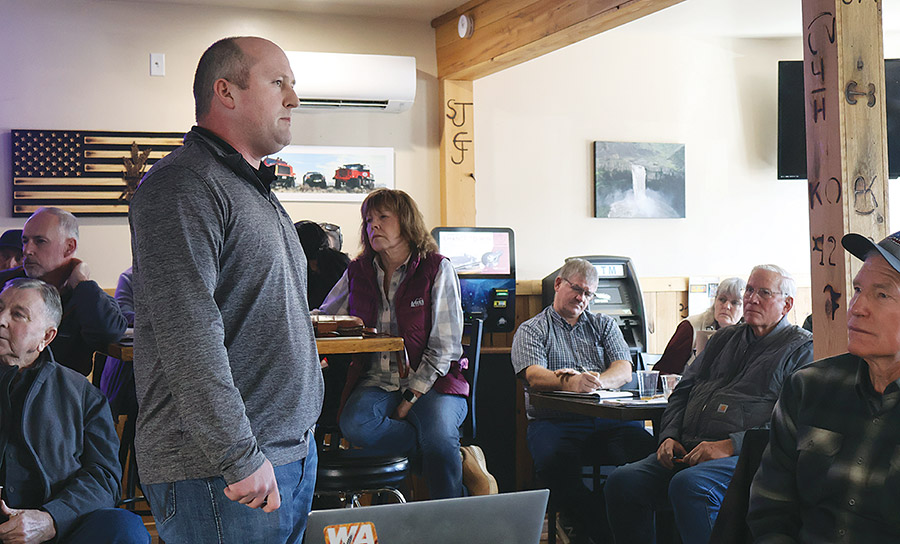
“Is it fair for the person not on the farm to get as much of the farm as it is for the person on the farm? That’s for the parents to decide, and it’s something to consider,” King said. “Have you communicated your intentions for your estate?”
Like Brock, King advocated carving off the operating side of the farm from the real estate and giving operational control to those working on the farm (as opposed to nonfarm family members). King presented an example where the parents want the farm to continue and wish to treat their two children fairly. One child returned to the farm after college, and the other has a successful off-farm career. The parent’s retirement is funded through a crop-share lease, and the land is protected by various LLC agreements. The on-farm son continues to farm and owns the corporation (the operating entity) outright, allowing him to make all day-to-day decisions without input from the off-farm sibling. Income from farm operations benefits those working the farm. The corporation pays land rent to the LLC, producing a steady income stream for each heir. This arrangement reduces the pressure to equally apportion estate assets. A buy-sell agreement in the LLC protects the on-farm child if the sibling wants to sell.
“My big takeaway is to communicate whatever your plan is. Have transparent conversations with the family, discuss expectations or goals, and communicate that with landlords,” King said. He also advised growers to expose the next generation to all aspects of farming, shift responsibilities over time, and facilitate ownership through gifting.