







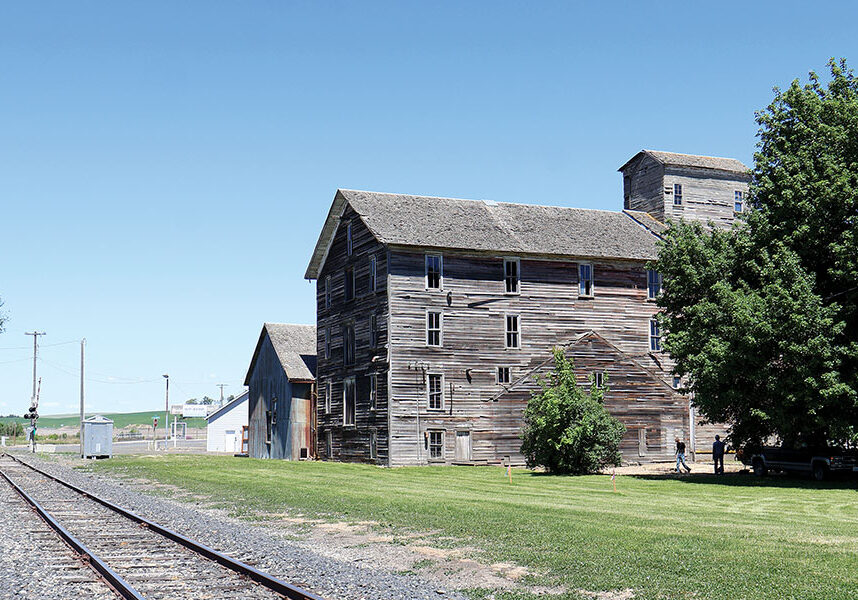
One of the most recognizable landmarks in the Palouse has been given a new lease on life, thanks to the community of Oakesdale, Wash., the Innovia Foundation, and the Port of Whitman County.
The Port was awarded a $1 million Community Economic Revitalization Board (CERB) grant in January to fund critical improvements to the four-story, 13,400-square-foot J.C. Barron flour mill in Oakesdale, including replacing the roof, stabilizing the building’s exterior, and extending water, sewer, and fiber utilities to the site.
“The community of Oakesdale has long had an interest in the mill. It’s the source of their annual town celebration, Old Mill Days,” explained Kara Riebold, executive director of the Port. “It’s the last standing mill in Whitman County, and they have a lot of pride in it and a lot of community stories around it.”
Ownership of the J.C. Barron flour mill was transferred to the Port in December 2024 after the Innovia Foundation worked with the community and donors to purchase the building. Riebold said a 2024 CERB grant funded a feasibility study to help the port work with the community to figure out the future economic development of the building.
“By the end of the year, that first phase of building stabilization will be completed, and we’ll have bought more time to refine the potential uses (of the building),” she explained. “We’ll spend part of the next phase trying to move forward with that and bringing the engineering alongside so we can understand what our next capital ask is in order to tackle the inside of the mill.”
Riebold said potential uses for the building vary and include retail space and/or event space, in addition to a tribute to the history of the building and the community. In the end, the building needs to support itself. The flour mill is located on Highway 27 and sees a significant amount of traffic go by.
“I think the community would like to see some kind of coffee shop or restaurant. The building is large enough that it lends itself to some mixed use,” she said. “We’re trying to be flexible in that vision. It might take multiple users or maybe one building manager who brings in multiple users to fill the space in a way that’s affordable for all and that can sustain itself.”
The building is on the National Register of Historic Places, and the port is working with the Washington State Department of Archaeology and Historic Preservation to meet the designation requirements. On the inside, the Port and many community members would like to see photographs and/or exhibits that illustrate the building’s original use as a flour mill; however, how the building will be used will likely dictate how the interior looks.
Community involvement has been key to preserving the building and will continue to be important going forward.
“I feel like this is one where the story’s really just beginning. It is the heart of the community, and the history of it is amazing,” Riebold said.
History
Editor’s note: Most of this information was taken from the 1977 National Register of Historic Places application.
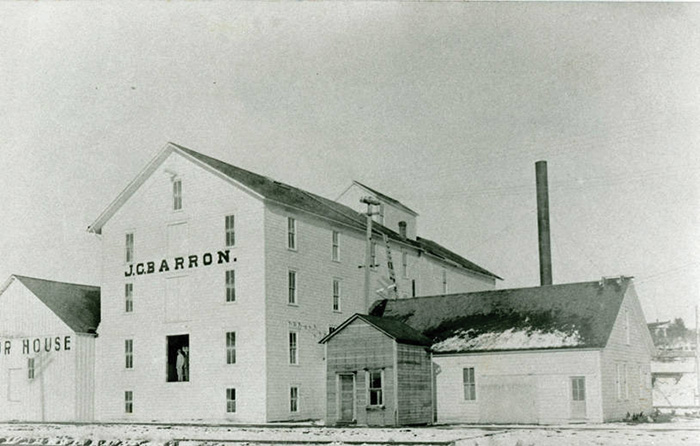
The Oakesdale flour mill was originally built in Illinois, and much of the structure and equipment moved to Oakesdale by J. G. Porter during the late summer and autumn of 1890. The steam-powered mill was running and flour was being produced on contract by December of that same year.
In July 1892, a fire burned down almost every other wooden commercial building in the town, but the mill was untouched. By the mid-1890s, the Oakesdale Milling Company, then the name of the operation, had gained a reputation for producing one of the Pacific Northwest’s finest flours. In December 1895, with J. A. Henry as the miller, the operation was running 24 hours a day. The output was kept small, with a daily capacity of 80 barrels (196 pounds per barrel).
To store grain for flour production, a crib elevator was added to the east face of the mill in 1898. The capacity of the four wooden bins was 20,000 bushels of wheat. Throughout the late 1890s, however, and until 1907, the mill was beset by financial problems. As well as frequent changes of ownership, including a sheriff’s sale of the mill in 1897 and the temporary closing of the mill early in 1898, a number of liens and mortgages were made against the property. This ended with the February 1907 sale of the mill to Joseph C. Barron.
Barron was a second-generation miller, his father having operated a water-driven grist mill in Pennsylvania. Barron ran flouring operations in Crawfordsville, Ind., and in Asotin, Wash., before coming to Oakesdale. Soon after purchasing the mill, Barron converted it to electricity and made the building housing the steam generator the family’s living quarters.
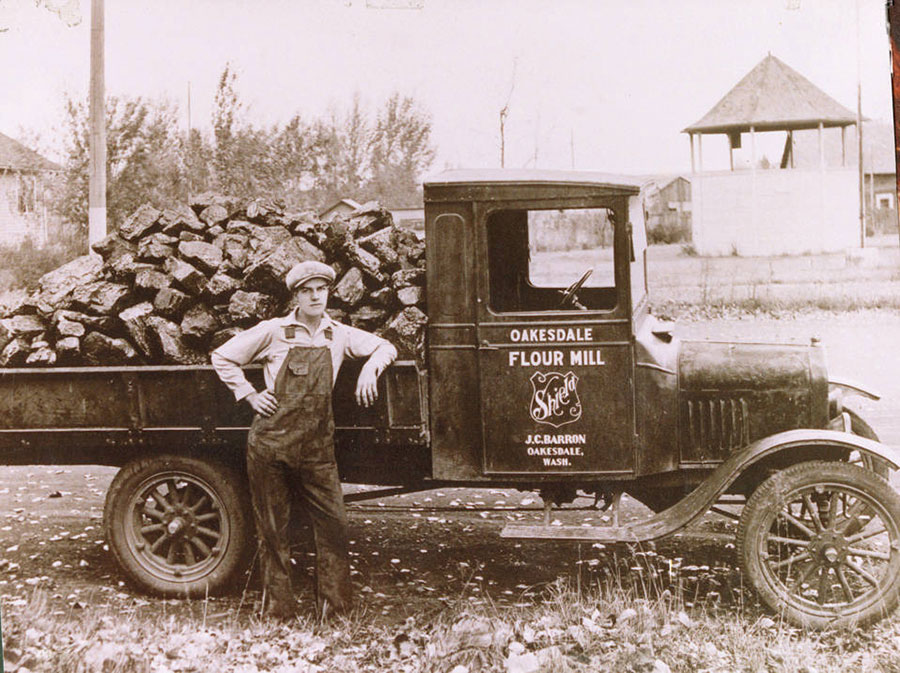
Barron successfully ran the Oakesdale flour mill for over 30 years, contributing significantly to the economic stability of the town. Barron died in 1955, and his son, Joseph Barron Jr., born in 1909, took over the business. The mill closed permanently in 1960, unable to compete with larger, centralized mills, but the junior Barron wasn’t done with milling. He set up a small electric specialty mill in his garage and made organic flours and cereals.
In 1998, Barron sold the mill and equipment to MaryJane Butters of MaryJanesFarm in Moscow, Idaho. Barron died in 2000. The building remained closed, although the new owner would occasionally open it for tours. Eventually, Butters put the property up for sale, and with the help of community donors, the Spokane-based Innovia Foundation bought the property in May 2024 and transferred ownership to the Port in December 2024.