





The devil’s often found in the details, and one Lincoln County grower is shifting through a wheat field of data to find answers.
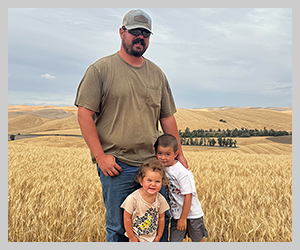
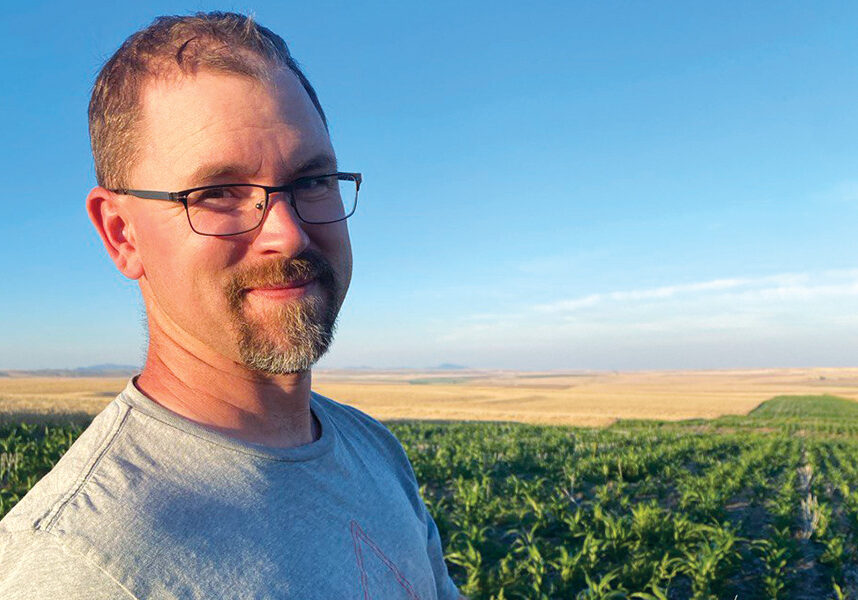
Jesse Brunner, a fifth-generation farmer north of Almira, Wash., is going into his third year participating in the Great Lakes Yield Enhancement Network (YEN). The program, which is based on a similar program in the UK, was started by the Michigan Wheat Board and the Grain Farmers of Ontario in 2021. Growers use an equation based on a location’s solar radiation and rainfall to come up with a potential yield number that they then compare to their actual yield. Data is collected throughout the year and compiled into reports (both group and individual) that growers can use. The Great Lakes YEN includes farmers not only from the Great Lake states and Ontario, Canada, but states like Missouri, Kentucky, and New York. Brunner grows mostly fall-seeded canola, wheat, and peas and is currently the only Washington state grower participating. He first heard about the Great Lakes YEN from listening to Peter “Wheat Pete” Johnson on YouTube. Johnson has been enthusiastic about YENs and was the featured speaker at last year’s Wheat College.
“I was very curious about it (the YEN),” Brunner said. “I think what makes them so interesting is the fact that you’re combining the collective data of all the growers involved, and you’re able to see, on a large scale, trends for what works and what doesn’t work.”
While the data might not directly translate from the Midwest and East Coast to the Pacific Northwest, Brunner said there are similarities, and a lot of the fertility information is directly applicable; he is tweaking his fertility program. How much of the other information translates to his own operation is something he is still figuring out.
“Not only am I able to make comparisons between what’s going on here and what’s going on back there, but I’m able to see what’s going on in my own field,” he said. “If we had a YEN in Washington, that would be amazing because then that would be a lot more relevant. But it is really interesting to see things like fertilizer rates compared to the Midwest or to the Great Lakes area.”
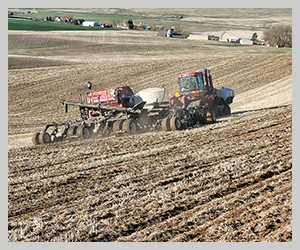
Brunner said his yields are in the middle range, but his seeding dates are much earlier than the other growers, and there are big differences in seeding rates. One of the most interesting things he has learned from his YEN participation is how much of his micronutrients are ending up in the grain compared to the Great Lakes area. Overall, there hasn’t been an “aha” moment. Besides tweaking his fertility program, he is also experimenting with narrower row spacing on his drill and playing with seeding rates. He said he is looking for multiple improvements that might make a 1% difference, rather than one big change.
“All that low hanging fruit has already been picked. We’re looking for 3% improvements, or even 1% improvement. If I can get 10, 1% improvements, 10% improvement is a pretty big deal,” he explained. “Life is all about managing expectations. I think the big thing that the YEN can point to is everywhere they’ve started one of these, they see a notable increase in the county average yield after about 10 years.”
To participate in the Great Lakes YEN, growers pay $325. The actual cost of participating is about $1,200, but the YEN is subsidized by Midwest grain purchasers who have a vested interest in increasing yields. After registering, growers receive a package containing everything they need to get started in collecting data.
Brunner said growers in the YEN are expected to collect a significant amount of data and keep meticulous records, such as soil tests, tissue tests, seeding dates and rates, variety planted, row spacing, chemical applications, dates when specific crop stages are reached, harvest dates, etc. At harvest, growers set aside a 3-acre plot that is harvested and weighed separately. Growers also submit field photos that are used to figure out head count and stand density. At the end of the year, growers get a “giant” report, but the data is kept anonymous.
“It sounds like more work than it is, but it’s not terrible, and they have made it as easy as they possibly can. They have all your sample containers. Everything you ship off, they already have the box with a pre-paid label on it. All you have to do is throw the stuff in the box and put it in the mail,” he said. “You’re going to get out of it what you put into it. You have to be willing to put the time in.”
Despite the work, Brunner said his participation in the YEN has been absolutely worth it. For those who are interested, he suggested talking to a grower who is in the program or giving it a try for a year.
“Get a copy of the final report and just see what kind of information is in there. It is a level of analysis that really blew my mind when I first saw it,” he said. “I really hope to see a program started here in the Pacific Northwest. I think it’d be a great value to our growers. Right now, it’s focused on wheat, but in other places in the world, they have them for other crops too, and that’d be really exciting.”
Brunner said growers are welcome to contact him at jesse.brunner@gmail.com if they have questions about his participation in the Great Lakes YEN. You can also find information about the program at greatlakesyen.com.