





Wheat College 2026 For producers, many small decisions can add up to increased yields
EducationHomepage Feature
By Trista Crossley
Editor
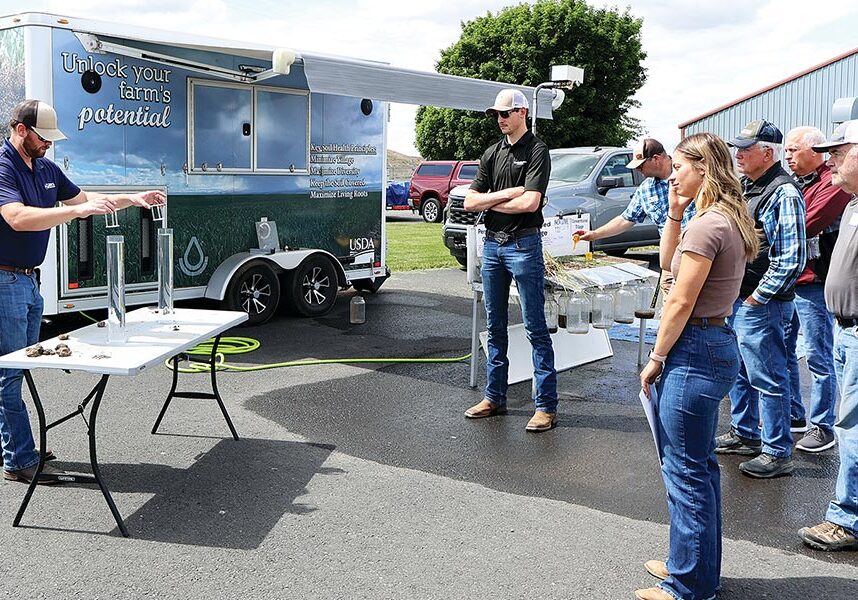
Unexpected neck surgery prevented the 2026 Wheat College keynote presenter from appearing in person, but growers were still able to take advantage of his knowledge as he zoomed in.

Following coffee and doughnuts sponsored by the Graybeal Group, Dennis Pennington, the Michigan State University (MSU) Wheat Extension specialist, appeared virtually to talk about making many small decisions for increased yields.
“What I’ve learned over the past years working with growers that are really working hard to push yields higher is it’s not a single decision or two or management practice that you can change on your farm that translates into those high yields,” he said. “It’s a series of small things that you do and do right, and when you add them up, that translates into higher yields.”
Increasing yields depends on the capture of three primary resources: solar radiation, nutrients, and water. Solar radiation provides energy for growth and development. The goal is to have a thick, lush canopy that stays green as long as possible. Pennington said the total amount of biomass that a crop produces has a direct relationship on yield potential. Growers need to make sure they have adequate nutrients, and the plants have a good root system that can take up those nutrients, as well as water.
“Those of you that are in a really water-stressed area, this is going to be a considerable limiting factor, and that’s what limits how high the yield potential is on your farm,” he said. “If you have that water restriction, these other two things become even more important.”
The foundation of yield potential starts with roots, which are needed for water uptake, nutrient acquisition, anchorage, standability, stress tolerance, and tiller survival. Roots have root exudates, chemical signals that detect changes in nutrient depletion zones from other nearby roots. Those root exudates influence how the plant grows. When many neighboring plants are detected, the root pattern is narrower with less lateral root branching and goes deeper, accessing deeper water and nutrients. This is good when water is limited, but it tends towards less tillers per plant and more early competition between plants.
In stands with lower plant density, roots have more lateral branching, a wider root spread in the topsoil, more tillers per plant, lower competition per plant, and more topsoil water and nutrient capture.
“One of the important things to take away is the way we manage our plant density is going to impact the way our roots grow. We need to think about seeding rates and spacing and where the plants are accessing nutrients and water,” Pennington explained.
Wheat plants have two types of tillers: first order tillers that have roots attached to them, and second order tillers that don’t have roots and get all their water and nutrients from the main tiller. Pennington said second order tillers only contribute to yield if the plant has enough water and nutrients to support them. He showed results from a MSU study on the impacts of seed spacing on tillers. The study found that the amount of tillers increased significantly as seeding rates dropped.
The study also compared tiller impacts from a precision planter vs. a drill. The precision planter started out with more tillers, but by harvest both methods ended up with about the same number.
“Ideally, we would like to maintain those tillers all the way to harvest because that’s going to really bump our yield production. When we lose these tillers, we’ve expended resources, water, nutrients to grow them, but then we’re not getting benefits out of it,” he said.
Why is tiller number so important? Using data gathered from the Great Lakes Yield Enhancement Group, or YEN, Pennington found that 900 to 1,000 heads per meter squared (3.6 to 4 million heads per acre) produces the highest yields; growers need between 52 and 58 heads per row foot.
“If you can only get two tillers to survive all the way to harvest, that means you need a seeding rate between 1.8 and 2 million seeds per acre, but if you can go to four tillers per plant, you can cut your seeding rate back considerably,” he explained. “That’s what we’re finding growers are doing in our YEN program. They’re cutting their seed rate back, because they’re able to get more tillers, and they’re still able to maintain these high head counts, which is driving a higher yield.”
In another MSU trial on planting date, Pennington planted plots every two weeks, from mid-September to mid-November. Each planting date also included five different seeding rates, from .8 million up to 2.4 million seeds per acre. As expected, they found significant differences in growth development. The trial showed that seeding rate didn’t make much of a difference when seeding early. High seeding rates at late-planted dates saw some increase, but nothing compared to the earlier seeding dates. Another study showed that increasing nitrogen, adding fungicides, or micronutrients couldn’t make up for planting late.
“Just by planting late, you’ve automatically lowered the bar for your yield potential. You have to plant on time. We can’t increase seed rate to fix this, and there’s no amount of management you can apply to fix a late planting date. You have to do whatever you can on your farm to figure out a way to get it planted on time.”
Another trial looked at manipulating seed placement and row spacing to increase yield. Michigan growers generally use a 7.5” row spacing. Researchers found that as row spacing increased, yield decreased. One surprising data point was a 5” row space gained 10 bushels over the 7.5” row space.
Pennington finished up his presentation by talking about the Great Lakes YEN, which is a collaborative program that helps wheat growers across the region better understand the gap between their actual and potential yields through field benchmarking and agronomic analysis. Data from the YEN supports the idea that biomass is a key to higher yields, as well as that split nitrogen applications are more effective than a single application.
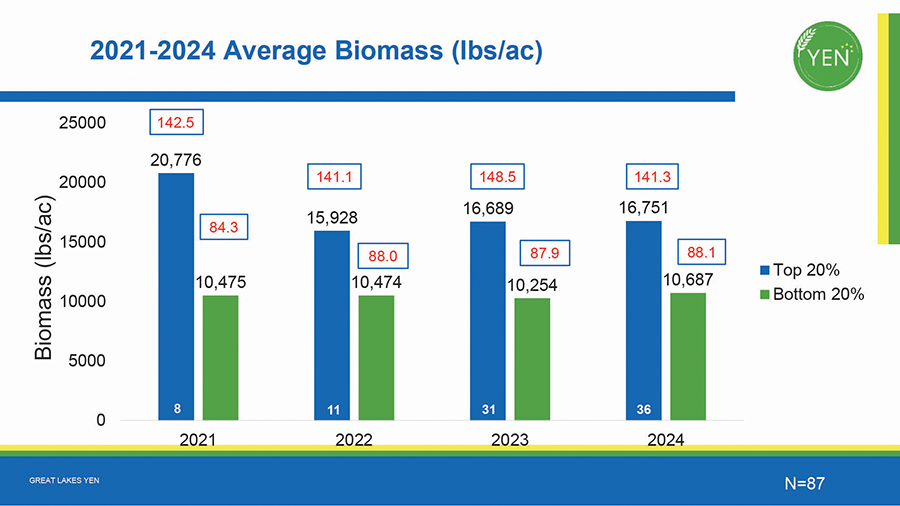
Common elements from the high-yield growers in the YEN include:
- Timely establishment. High yielding crops are planted within the optimum planting window for their region. You can’t compensate for that.
- Optimize head counts. High-yield crops have 800+ heads/per meter squared. Earlier planting, more fall tillering. Seeding rate and row spacing make a difference.
- Maximize biomass. High yielding crops produce more than 17,000 pounds of biomass per acre.
- Attention to detail. High yielding growers make timely input applications based on crop stage and needs.
“There is not one thing that the high yield growers do. It’s a series of decisions that they make. They’re constantly out there scouting their crop and paying attention to what’s going on, and then they make adjustments to their program on the fly based on what they see in the field,” Pennington said.
2026 decisions, 2027 impacts

Sam Kimmell, The McGregor Company’s business unit manager for the north Palouse, keyed in on how 2026 input decisions could impact the 2027 crop. He began his presentation by acknowledging the past.
“It’s important to remember that the things that worked at times that are similar to these are oftentimes the same things that will work on a year like this,” he said.
In the fall of 2025, most Eastern Washington growers were facing extremely dry seeding conditions, but that soon turned around. A warm, wet winter allowed for a big accumulation of growing degree days. Early-planted wheat did better with above average fall growth, lots of tillering, and active roots and above-ground growth almost all winter.
“There’s some baggage that came along with that, with disease and insect pressure, but the guys that planned for the best, prayed for the best, are singing from the hilltops a little bit right now,” he said.
Kimmell said there are three yield components that a grower can impact: heads per acre, grains per head, and weight per grain. Each component has a window when it’s most sensitive to stress, but also when it’s most responsive to inputs. Once a component is set, growers generally cannot rebuild it, only protect it. Kimmell focused on heads per acre, calling it one of the easiest levers for a grower to pull.
Seeding rate, seeding date, variety, and row width can all impact heads per acre, but data from a multiyear trial by The McGregor Company (TMC) shows that seeding date is by far the main factor, accounting for 47.3% of variation. Variety and planting date was second at 18.7%. Seeding rate was negligible as a main effect.
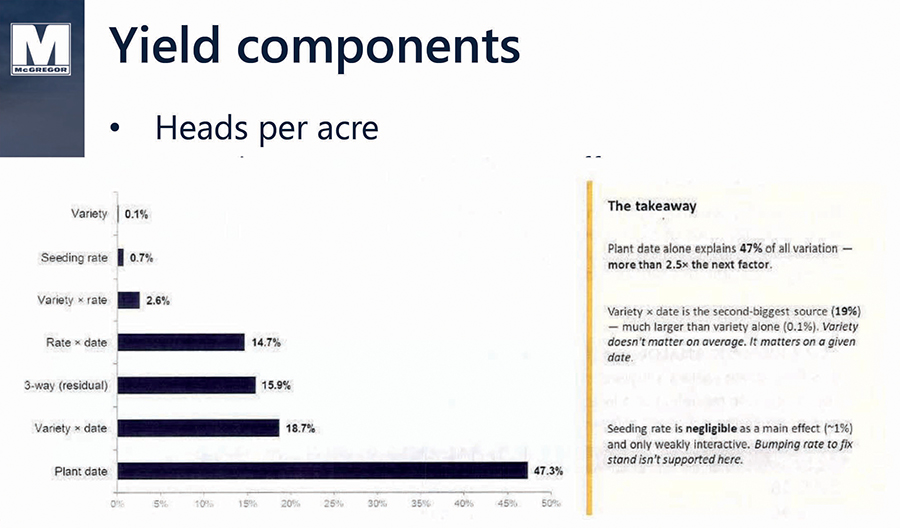
“Variety almost didn’t matter when the plant date was right,” Kimmell said. “If you’re going to plant late, picking the right variety swung pretty big, too. It was kind of eye opening.”
In the trial, TMC researchers seeded plots in successive weeks beginning in mid-September through the end of October; everything else — fertility, variety, seeding rate — was the same. What they found was every week of late planting cost growers about three bushels per acre.
Other benefits of timely seeding include:
- Dealing with grassy weed issues. Pre-emerge chemistry likes early seeding times and beating the first germination rain in the fall is paramount. Kimmell advised growers to seed problem fields first and get a pre-emergent on. “Put the dollars where it might make a difference and then adjust.”
- Crop competition. One of the greatest weed control tools that growers have.
- Root development and access to nutrition.
- Looking ahead to this fall’s planting, smart fertility decisions are critical. As input costs rise, a lot of growers may be thinking about cutting back. Kimmell said that’s fine on nutrients that growers can catch up on, but not for those they can’t.
- Avoid cutting back on phosphate and zinc, especially zinc, which is good for tillering.
- Chloride is very mobile but has decent demand in fall and spring. Back off fall chloride and make it up in the spring.
- Nitrogen is a big one, so look at it objectively. “We have lots of growing degree days, maybe the best in the world if we can avoid a March frost.” Nitrogen application can be risky without rain.
- Sulphur is an important nitrogen efficiency number. It curves with nitrogen demand and is hard to catch back up on.
“Falling behind can’t be an option in tough times,” he said. “On fertility decisions, my head still goes to efficiency. I think that’s a lever we need to look at more.”
In some of the higher rainfall areas, nitrogen stabilizers might help avoid top dressing in late fall or early spring, and variable rate technology can help direct inputs where they’ll make the most difference.
“Honestly, this sounds silly, but one of the simplest, easiest lever wins is to move some of your nutrients from your highest or lowest production ground and put them in your medium production ground. Suddenly, your average goes up, because you’re over fertilizing some of your ground, and you’re under fertilizing some of your ground. But that middle zone, it’s going to pull up your average, right? I know it sounds simple, but that works really well, and it’s fairly inexpensive,” Kimmell explained.
Kimmell’s take-home advice was:
- Set the crop up for success and adjust as needed. Look objectively at your base fertility package. Don’t cut fertility to the point of no return and apply nutrients at the right place at the right time.
- Set an enterprise budget and do your best to stick with it.
- Be willing to try the tested but shy from the unproven and rely on local research and local experience.

Industry updates
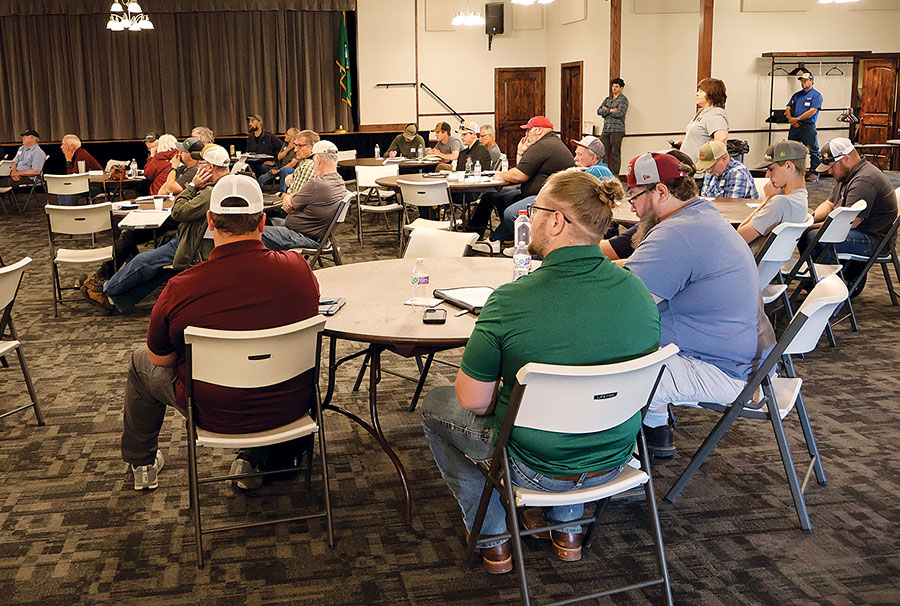
Following the main presentations, growers heard updates from industry leaders.
Dr. Sieg Snapp, associate dean for research in Washington State University’s College (WSU) of Agricultural, Human, and Natural Resource Sciences, told growers that the college just interviewed a third candidate for the Washington Grain Commission-funded weed science endowed chair. Her job is to make sure WSU staff are listening to industry about how to improve crops.
Kevin Klein, chairman of the Washington Grain Commission (WGC), talked about how the WGC is investing grower dollars in research, market development, and education. The variety testing program has had some difficulties recently, but breeders Mike Pumphrey and Kimberly Garland-Campbell have stepped up to keep it going. A new research subcommittee is helping to direct research dollars and provide more grower feedback to researchers. Summer is trade team season, and the WGC would like to increase grower participation.
Washington Association of Wheat Growers (WAWG) President Gil Crosby reviewed the association’s efforts during the 2026 Washington State Legislative session, which included getting a seasonal overtime exemption, a permanent exemption for lubricants on Climate Commitment Act taxes, and protecting ag tax exemptions. In national legislation, the farm bill is in the Senate Ag Committee after passing the House in April. While many of the farm bill’s provisions were funded in separate legislation, important programs like the Conservation Reserve Program were not. Crosby also touched on continuing lower Snake River dam litigation and reminded growers of the annual convention, which will take place Nov. 30-Dec. 2 in the Tri-Cities and include growers from Oregon.
Rotational topics
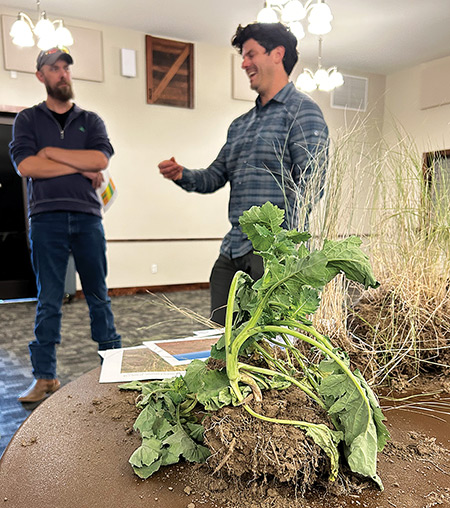
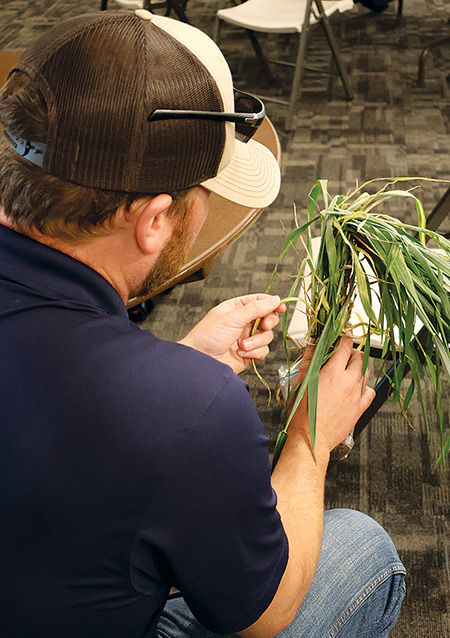
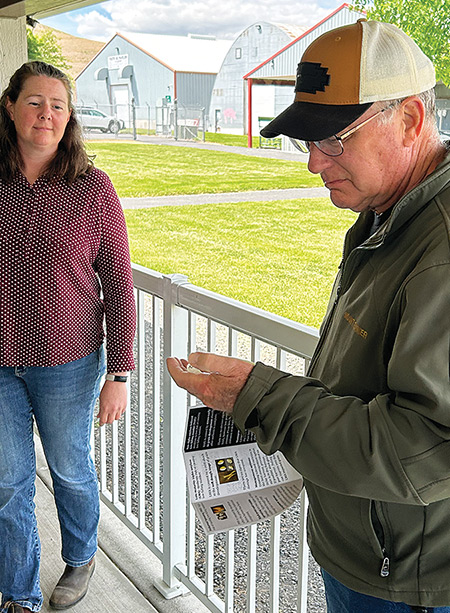
Wheat College wrapped up with four rotational topics. Morgan Menaker, the Washington State University (WSU) regional Extension agronomist for Whitman, Asotin, Columbia, Garfield, and Walla Walla counties, talked about the recent discovery of Soilborne Wheat Mosaic Virus in Whitman County. See article here.
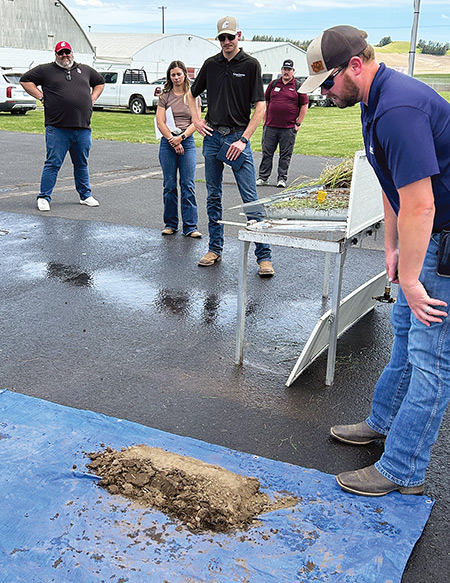
Researchers Amber Hauvermale and Alison Thompson gave an update on falling numbers and efforts to develop a quicker, more reliable test. Stephen Johnson from the Natural Resources Conservation Service (NRCS) talked to growers about taking land out of the Conservation Reserve Program and putting it back into production. Mitch Ruchert brought NRCS’s rainfall simulator to demonstrate the impacts of soil health on runoff and erosion.
AMMO sponsors
The 2026 Agricultural Marketing and Management Organization schedule, including Wheat College, is possible with the generous support of these sponsors:
AgWest Farm Credit
Almota Grain
HighLine Grain Growers
JW & Associates, PLLC
Leffel, Otis & Warwick
Northwest Grain Growers
Patton & Associates LLC
PNW Farmers Cooperative
Ritzville Warehouse Co.
The McGregor Company