



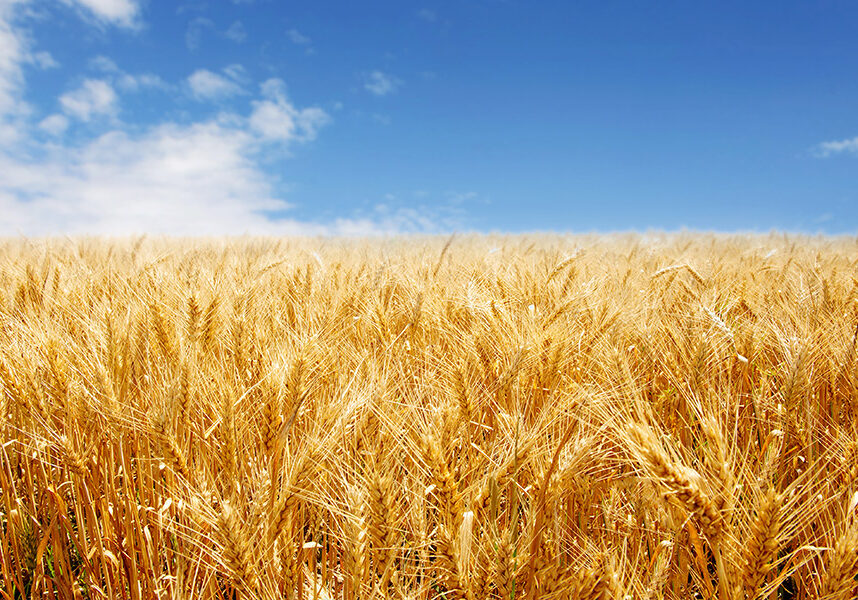
When William Jasper Spillman began applying Mendel’s Laws of genetics and inheritance to wheat improvement in the 1890s, he set in motion a tradition of agricultural research that has defined Pacific Northwest farming ever since. By 1958, the industry’s needs — for new varieties, tools, practices, and education — had grown beyond what universities, the U.S. Department of Agriculture (USDA), and private companies alone could meet, giving rise to the grower-funded assessment system. The Washington Grain Commission (WGC) is now adapting to current challenges with the Research Advisory Subcommittee (RAS).
The RAS, a dedicated, farmer-led group that respects the limited time of volunteer growers while creating space for strategic, long-view thinking, brings singular focus to the research and extension needs of Washington and Pacific Northwest grain farmers. Beyond portfolio management, the RAS is equally committed to deepening grower involvement, from the annual research review to direct access to the latest research findings.
WGC-funded research fills a gap that neither public institutions nor private companies can close alone, tackling problems of direct strategic importance to Washington grain farmers that lack both sufficient public funding and private profit potential. That investment, combined with the targeted endowment of faculty positions at Washington State University (WSU), has built something invaluable: a standing pool of expertise that survives budget cycles and stands ready to respond when the industry needs it most. When falling number alerts threatened export contracts, when a GMO release hit production fields, when Hessian fly emerged and new stripe rust races evolved, that network mobilized rapidly because the relationships and resources were already in place.
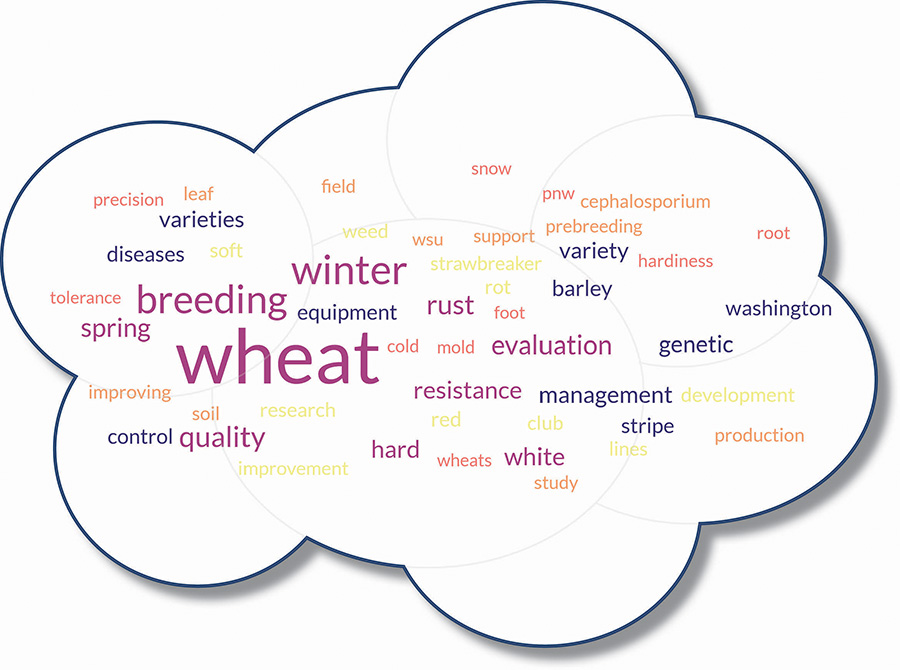
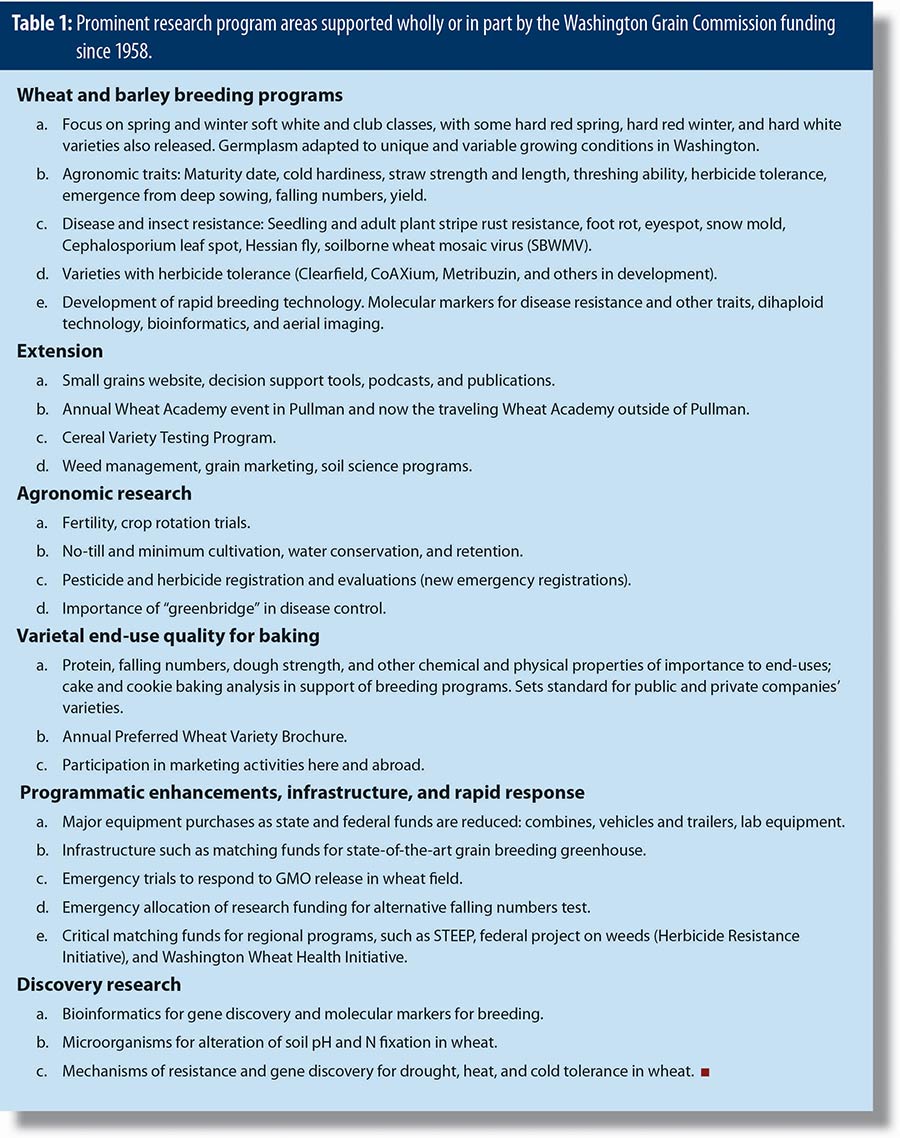
The WGC invests about $2 million annually in research, with the core portfolio spanning breeding, Extension, variety testing, and quality assurance to ensure new varieties meet market standards (Table 1). Projects address both near-term challenges and longer-horizon needs, such as heat and drought tolerance. Notably, innovative faculty have also leveraged WGC funding to attract additional USDA and National Science Foundation grants, multiplying the WGC’s return on investment. The diversity of the research portfolio is captured in the word cloud below.
Following discussions over the last couple of years at the WGC and the Washington Association of Wheat Growers (WAWG) meetings, the need for and focus of the RAS ultimately crystallized around two priorities: the stewardship of the research portfolio itself and the specific responsibilities that would be asked of individual RAS members.
Recruiting farmers into leadership roles is never easy. Time is the scarcest resource in agriculture, and asking growers to take on meaningful RAS responsibilities demands thoughtful consideration. Recruiting was critical. The RAS must be representative of the diverse environmental and geographic growing regions in Washington. To achieve the breadth of coverage of the Washington grain industry, the WGC commissioners decided the RAS should have 10 members: two WGC commissioners, the research chair from WAWG, one grower from each of the five WGC districts, and two at-large grower members. A member of WGC staff and the WSU liaison serve as ex officio members. The seven grower members were to be neither past WAWG board members or past WGC commissioners. Nominations for the RAS were solicited from WGC commissioners, WAWG board members, county grain grower presidents, researchers, and industry. It was considered essential to have nominations from the group they represent to have knowledgeable, accountable, and dedicated members of RAS. A document describing RAS and individual responsibilities and expectations was shared with each nominee prior to selection.
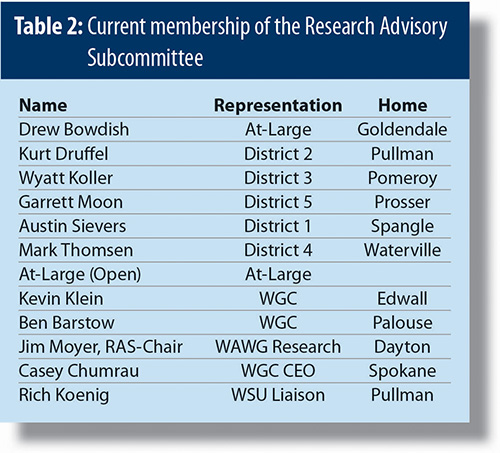
Eighteen grower nominations were received, and seven were selected. One at-large member was left vacant to allow the opportunity to meet an unanticipated need. The current RAS membership is listed in Table 2.
The RAS held its first organizational meeting at WSU on Jan. 13–14, 2026, refining the review process through meetings with researchers, administrators, and a tour of research facilities. A new review model was introduced: each member now carries primary responsibility for three WGC-funded projects and secondary responsibility for three more, maintaining oversight from initiation through completion. This replaces the previous structure in which all WGC commissioners were responsible for more than 25 projects. Having fewer projects enables members’ deeper engagement on individual projects. The annual Research Review followed on Feb. 19, 2026, after which the RAS provided funding recommendations to the WGC and improvement suggestions and feedback to project leaders.
Moving forward, the RAS is initially scheduled to meet three times annually:
- A business meeting to review preproposals for “new” projects, assess strategic priorities, review programmatic areas, and implement changes designed to increase grower involvement.
- A meeting for an in-depth review of each project.
- The annual WGC Research Review of new and renewing project proposals where presentations are made by project leaders to growers.
The RAS has begun discussions regarding improving the WGC Research Review to engage growers and to make research proposal information more widely available, as well as results of completed projects. The RAS welcomes input from all stakeholders in its efforts to be more strategic and responsive to farmers’ needs.